Museums appealing to children are often a great source of interactive websites. I liked this website years ago (see the blast from the past) and the now Plimoth-Pawtuxet Museum has redesigned it with a modern look and perspective. Pre-and a little post-Thanksgiving, you could bring some groups through this "adventure," the conceit being you are a teenage reporter investigating some Wampanoag and Pilgrim sites. I might be biased as a Massachusetts guy, but it's a nice site for students to practice discussing what they see in pictures, processing information, and there are some sequencing and word-fill interactives. There is a lot of content here and seemingly no way to save progress, but you could just visit a few of the sites or keep tabs open if you want to continue.
Thursday, November 17, 2022
Friday, November 11, 2022
Book Creator Templates (including Thanksgiving!)
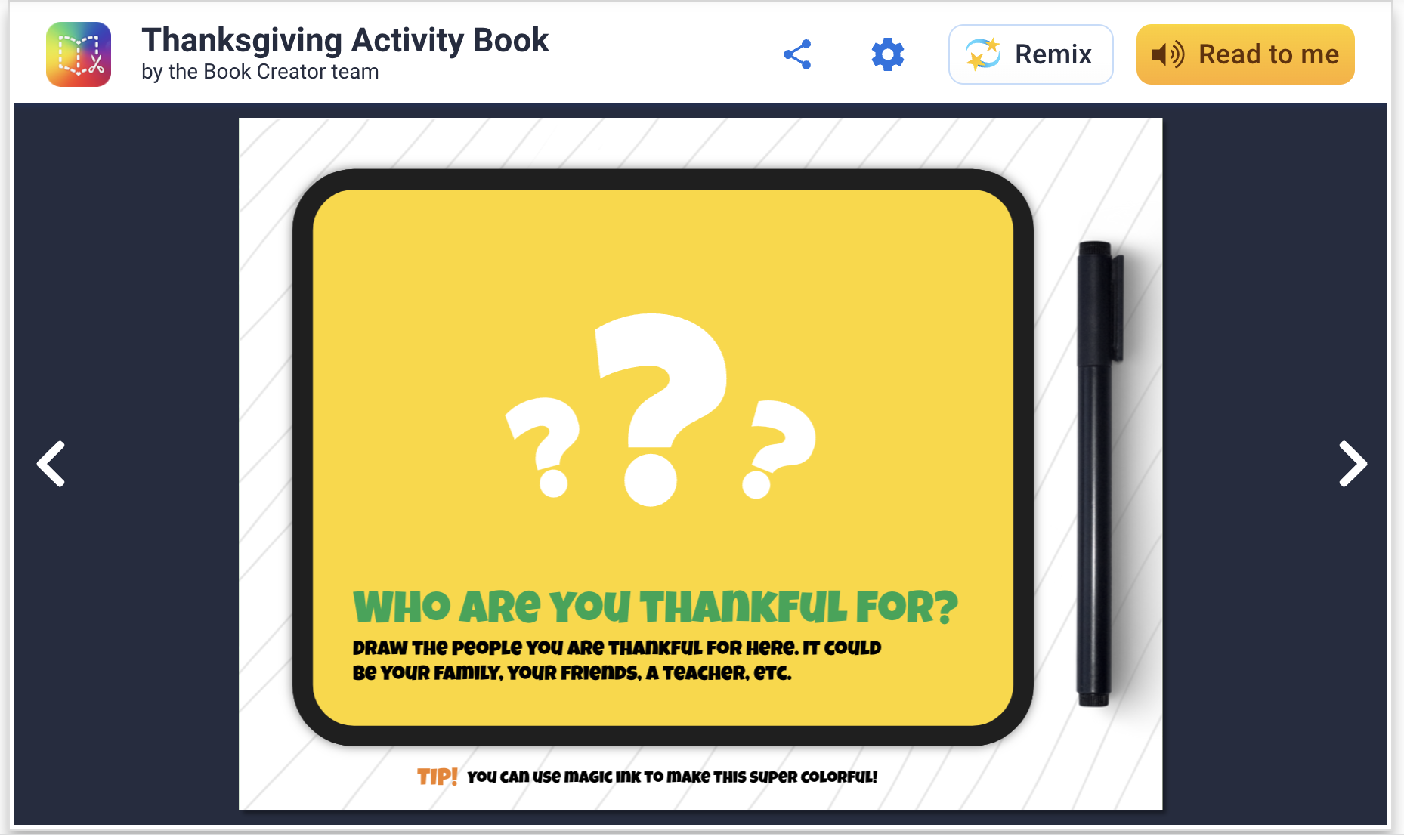
Book Creator has long been a stellar app/webtool and recently I discovered that they have templates to "remix." You can add templates to your app and do a collaborative work on your iPad among students, or if in a Chromebook environment your free account will allow you to share with students' Google accounts easily. This is an attractive option because, well, they are attractive and you don't have to design the book yourself. Richard Byrne describes the magic ink and autodraw features here.
These "activity books" are filled with language underpinnings like storytelling opportunities, semantic knowledge and vocabulary. You can easily copy and modify any page to cater to your students before starting the activity. For example, on this page below, you can zoom in on a map and have kids in the group find out where others live (generally) for spatial/academic/biographical knowledge of others. Additionally, with this template, gratitude is literally good for your brain to practice all year long.
Friday, October 28, 2022
Monday Halloween?
Looking for an engaging activity this Monday? Check out this fun one from Control-Alt-Achieve (also a great resource in general). In this you use Google Docs as a visual creator to make a Halloween "Rebus" story. I have mentioned before the principal that typing into a white space is a visual support for language formulation and (many of) your students will be engaged by it- tech integration need not always be super interactive or fancy! This activity integrates the use of emoji and don't miss the way expanded context provided by going to what is now available as Insert>Emoji. How fun! I did this activity with several middle school groups this week and they were super-engaged. In addition to targeting some story grammar, complex sentences or vocabulary, I integrated the work described in this ASHA article to make this an improv game focusing on conversation building and flexibility. Note: I always accompany some encouragement of "yes, and" with neurodiversity- and human-affirming takes on "it's also ok to say no."
Friday, November 6, 2020
A focus on gratitude
Gratitude is a Thanksgivingy theme...but actually much more than that. Much research has supported that practicing gratitude as a form of mindfulness can be self-regulating and cultivate positive neural connections.
In addition, gratitude has a language lens as it:
-relates life experiences
-can/should be practiced as a "listing" activity
-expresses causality
-can be pushed to the abstract i.e. being grateful for intangible things.
Over this and coming weeks I will be using this and this video in discussion activities.
Thursday, October 22, 2020
Google Earth's Spooky Spots Quiz
You know I am a Google Earth Geek. Always have been, but in this time it is nice to be able to use the context of "going someplace" to engage my students. Google Earth's quizzes (find in the Explorer captain wheel tab) provide very structured experiences with the interactive globe, posing questions, providing images that prompt observation and discussion, and popping you into an interactive window to "look around." With Halloween coming, you can use the Spooky Spots quiz through nine multiple choice questions (it doesn't matter if you or your students know the answers) bringing you to spots around the globe. The content is free of violence but mentions "The Shining" and "Rosemary's Baby" so probably best for 5th grade or above. As each question is posed, unlabeled placemarks would allow you to ask students to observe potential locations (e.g. "that one looks like its Colorado."). Once answered, you can use the interactive window on the left to navigate the space (oooh an abandoned amusement park near Chernobyl) and work on description and conversation. You may be interested in asking group members to get more information on one of the topics and report back to the group (Wikipedia is fine for general knowledge!).
Friday, October 9, 2020
Therapeutic Gaming Can Be Messy...
...and that's ok. Particularly in social intervention contexts, it's important to facilitate natural situations. That includes trying and failing with games- either because the group doesn't like the game and wants to try something else, the game itself sucks, or for other reasons. Isn't that what friends do when they get together-- evolve "group plans" and move on when something doesn't work for the group (see Social Thinking® Group Plan concept)? I like to use games within intervention sessions as a seeming reward near the end, but in themselves they have working teachable moments and lots of opportunities for my students to practice self-regulating. In teletherapy, with or without cursor control (have the students tell you what to click on), you can try a flash game like this (seasonal!) corn maze. Flash games come in a wide range of quality but this one is not bad at all!
While accepting that games like this might not go perfectly in a group, we can prepare to facilitate success. Notice that button that says "walkthrough?" In this case it leads to a video that shows you a sped-up view of game moves. For most other games, you can find a walkthrough with a Google. This arms you with information so you can provide cues like "Oh, what do you think that quarter will be for? What might you buy in a corn maze? Oh, nice smart guess!"
Friday, October 2, 2020
Full Moon
October has two full moons, including the current one! Full Moon is a good example of the kind of game adaptable to therapy given a task analysis.
In this game you navigate a bunny through various levels to get what he wants. In the above level, to get the apple, you have to infer that you need to click on the light bulbs, discover that the middle one turns all the bulbs off, illuminate the apple (in the right tree) and click the apple to drop it to the bunny.
This game prompts:
-use of remote cursor control, or perhaps not (might be better if students have to tell you what to do)
-spacial concepts
-cause and effect reasoning
-observation, collaborating and conversation
It is untimed so you can move at any pace you wish. Plus it has thought balloons which I love in any context as a social cognitive symbol! Here's a walkthrough (always useful if you are going to use games in therapy).
Thursday, June 18, 2020
Juneteenth: a sequence and settings
Monday, July 1, 2019
Repost: Play with Fireworks Virtually (IRL leave it to the professionals)
Interactive apps have long been one of my favorite topics because they replicate world schema, and every schema has language that goes with it. As the 4th approaches (or other holidays in the future), you may have fireworks on your mind.
Apps give us a window to simulate removed events (and safely!), so you might be interested in Fireworks Lab. This free app allows students to organize and operate a fireworks display. The app is gloriously language-neutral, so students can be encouraged to label their choices in elaborated noun phrases (e.g. "green sparkly rocket") and then set them off.
A few supplemental ideas:
-The app is perfect for pairing with a written language or reading activity. Write or sequence cards with the different attributes of the fireworks and use these as a "plan" for the display.
-Have students research fireworks displays in your town, or for older students, pair with the story of this famous fireworks fail for a narrative activity. The article is safe to use with kids and has some good figurative language too!
Have a happy (and SAFE) 4th of July--and to my Canadian friends, Happy Canada Day!
Considering your professional development schedule next year? Check out Sean's offerings for training sessions.
Thursday, October 25, 2018
Lesson: 5 Point Scale of Halloween Problems
So I made you a lesson! Use this Google Slides, uh, slide as a template to have kids generate examples of problems that occur on Halloween. I like the framework contained in both this TpT packet by Speechie Musings and Social Thinking's® Size of the Problem book: problems become bigger with 1) time needed to solve 2) needing help 3) someone being physically or emotionally hurt and 4) affecting other people. So, a 3 might ruin your day (time) and cause light physical or bigger emotional hurt, and you may need to talk to someone about it.
You can use humor and lightness/darkness appropriate to your group in developing examples, so, a 5 for your HSers might be "your friend becomes a zombie" where with 2nd graders maybe "a ghost decides to live in your house."
To use this template, please do not request access. That results in my getting emails...thanks. Open a browser and sign into your Google account. Go to this link. From the file menu, choose Make a copy. Then it is yours. Consider duplicating the slide or the file itself to use for many groups. Also, Tools>Explore will let you search for images to add extra visual support (e.g. "throwing up," a 3). This activity is great for pairing with a book about Halloween.
Have a great Halloween!
Thursday, December 14, 2017
A Holiday Lesson...
You can do an actual gift exchange if time permits, or use an empty box or gift bag for pretend play, but there are some ways to tech up this lesson and add context, strategy and social cognition concepts, and engagement.
This coming week I am going to have students prepare for this activity by reading Llama Llama Holiday Drama (it's available on Kindle if you don't have time to get it). This book explores anxiety and mindfulness, and contains some good "hidden rules" about the season and the meaning of giving gifts. It is also multi-denominational.
I created a thinksheet for the activity which you can access here. Feel free to Make a Copy under File if you would like to modify it for your purposes.
As you can see, the preparation steps will target asking and answering questions, using wondering and People Files about others (Social Thinking®), as well as categorization and making choices. The "Levels of Like" concept is one I learned from SLP Jenny Sojat. She presented on this at a conference and uses this to make group decisions- poll group members to get them to state whether they love, like, are ok with (the "yes" line of compromise) or dislike an idea such as an outing, game, snack, etc. In this case students would just be using to to gauge another's opinion.
Have students save a photo of the "gift" they will be giving. On iPad you can look up photos in Safari, tap to enlarge, then tap and hold to save to the Photos app. If you want to add math concepts and flexible thinking, give them a budget and ask them to look up the item on Amazon.
I'd suggest "wrapping" the gift with Bag Game. It adds an element of a hidden item as the student hands the other student the iPad.
Pre-exchange, the 5 Point Scale provides a great tool. You can emphasize the perspectives and reactions of the giver at each level as well. I like to develop scales with students by using anchor points such as a 5 and 1 and having them label the other levels.
Then, exchange by having students deliver their iPad "gifts" to each other! Another good strategy is to provide an explicit challenge to students to generalize the concepts and report back. For example, ask students to be aware of their reactions when receiving gifts and report back on them. This is always a good narrative development activity as well.
Happy Holidays!
Friday, October 27, 2017
Haunted Listening Practice
-The game is a choose-your-own-adventure style activity where a walkthrough of a "Haunted" House is narrated and you are provided with choices, thereby providing a narrative.
-We imposed a "round the table" rule for answering Alexa, in the process working on "group plan" and whole body listening.
-The auditory input gives you an opportunity to work on the skill of visualizing- consider using your Visualizing and Verbalizing® structure words or having the students sketch a collaborative "map" of the house and the events in different locations, Stickwriting Stories style (Incidentally, there's a good "Scary Visitor" story here to model).
Saturday, October 24, 2015
Toca Boo- Currently Free and Full of Fun Scares
This highly interactive app allows you to play the role of a "ghost" and wander a darkened house scaring members of a family. Seems a strange concept, but it's loads of fun.
Have you ever played hiding games with kids who proceed to hide themselves or items in plain sight? This illuminates, pun intended in the context of this app, problems around perspective taking and "thinking with the eyes" (see the work of the folks at Social Thinking®). In Toca Boo, to achieve a maximum scare, the ghost needs to avoid the family members' flashlights and hide in hotspots (e.g. under the covers of the bed or in a box) or behind furniture. Watch the trailer below:
The process of coaching students to effectively scare the characters will give you the opportunity to model and elicit if/then and causal language, as well as target spatial and positional concepts, in addition to the social cognitive ideas mentioned above. The app provides a good context for building the category of rooms of a house as well.
Do use your judgment of the trailer to consider which of your students would like this app, and whether it might be too scary for some. I do think they go a little far in having you scare (and knock over) the comical older man with the cane. I admit I laughed at this, though (America's Funniest Home Videos being a guilty pleasure of mine)! Toca Boca as always does a good job of discussing the ideas around the app in the "For Parents" section of the app, but I'm a believer in a little scare, suspense or humor being a great context to get kids talking.
New idea: try following this app with some dramatic play, perhaps filming with your video camera an "unsuccessful scare" vs. a "successful scare," at the same time targeting the sequential language of hiding and popping out and some feelings vocabulary.
Saturday, October 25, 2014
Toca Boo!
This highly interactive app allows you to play the role of a "ghost" and wander a darkened house scaring members of a family. Seems a strange concept, but it's loads of fun.
Have you ever played hiding games with kids who proceed to hide themselves or items in plain sight? This illuminates, pun intended in the context of this app, problems around perspective taking and "thinking with the eyes" (see the work of the folks at Social Thinking®). In Toca Boo, to achieve a maximum scare, the ghost needs to avoid the family members' flashlights and hide in hotspots (e.g. under the covers of the bed or in a box) or behind furniture. Watch the trailer below:
The process of coaching students to effectively scare the characters will give you the opportunity to model and elicit if/then and causal language, as well as target spatial and positional concepts, in addition to the social cognitive ideas mentioned above. The app provides a good context for building the category of rooms of a house as well.
Do use your judgment of the trailer to consider which of your students would like this app, and whether it might be too scary for some. I do think they go a little far in having you scare (and knock over) the comical older man with the cane. I admit I laughed at this, though (America's Funniest Home Videos being a guilty pleasure of mine)! Toca Boca as always does a good job of discussing the ideas around the app in the "For Parents" section of the app, but I'm a believer in a little scare, suspense or humor being a great context to get kids talking.
Thursday, March 13, 2014
Have a "Smashing" Saint Patrick's Day
St. Patrick's day can indeed be about more than the stereotypes (no comment, but I am too old, basically, anyway), and this week I used the context to do an activity about positive self-talk. In a brief lesson we illustrated how our self-talk can influence our feelings and therefore our social behaviors- it's the difference between "Lucky Thinking" and "Unlucky Thinking."
Have fun with App-Smashing!
Thursday, December 12, 2013
When apps go away, be creative!
Here's the thing: it's no longer available in the U.S. Store, as I discovered when I sat down to write this post. Crap! Though I have it on my iPad, you can't get it, at least for now.
I couldn't find anything else like it!
EDIT: Rachel Smith on Twitter (@lancslassrach) alerted me to the free Wrapped app (works better on iPad). It's a little less slick but serves the same purpose/features (see below)
but when I sat and thought about its process and features:
1. Save a photo of a gift using Safari
2. Add it to the app (or have student do steps 1-2) so it is "hidden"
3. Practice all the verbal and nonverbal behaviors that go with a gift exchange
...I realized that All4MyChild's Bag Game ($1.99, also available in the excellent Social Adventures app) could be used in just the same way! Just save the pic to the camera roll in Safari and choose "Hide Photo." Notice my racetrack pic on the camera roll.
The wrapping may be simple, and you can opt to skip the guessing game, but the idea is the same. The receiver can pinch to open the gift, and there you go!
Common Core Connection:
Happy Holidays to you all!
Want to give me a gift? Vote for me for Best EdTech/Resource Sharing Blog in the 2013 Edublog Awards!
How?
Click on the link above. Find "Speechtechie" and click on the arrow up button in lower left.
Sign in to list.ly with Facebook, Twitter or Google. You can "skip" letting listly post for you.
You haven't voted yet. Click the arrow up button again in my "rectangle." Now you've voted.
Voting is open until 12/18. Please also support other SLPs in the running. You can vote for all of us, even multiple resources in a category, but only once each. Thanks!
Tuesday, October 23, 2012
Appy-Picking Month: It's the Great Pumpkin, Charlie Brown
Monday, October 22, 2012
Appy-Picking Month: A Reminder about Scan
This post is also timely because I have a Spooooky Halloween Lesson involving QR Codes and Story Mapping from last year I would love you to use, whether or not you have a Story Grammar Marker (though you should get one)!
Note: author is a contractor for Mindwing Concepts and provides blog content
Thursday, October 20, 2011
LearnEnglish Kids' Haunted House
![]() |
| The clues are presented in a rather unsettling voice, so make sure you preview it and use with "no tears" kind of kids! |