Last month, ASHA Leader featured a helpful article, Using ChatGPT to Create Treatment Materials (Price, Lubniewski, Du) providing great examples of prompts to ChatGPT for creation of sound-loaded paragraphs. Key to the article is the idea that what is returned will need to be filtered through your clinical expertise to create a usable material.
I have found that this process is still "quick." Recently I have been using a student's interest, in this case, cooking shows, to work through comprehension of paragraphs. We use strategies such as noticing and breaking down elaborated noun and verb phrases and also visualizing, with light application of the Visualizing and Verbalizing methods (structure words and digital squares in place of the "felts"). Though Lindamood-Bell provides quite a bit in terms of content with visual imagery for free, I have wanted to cater the content more to his interests and use subjects like Ina Garten.
Here you can see that the original return contained too much complex vocabulary, so you can use the chat aspect of the tool to continue refining. After simplifying the vocab, I asked it to detail a specific recipe like lemon chicken, then needed to ask it to simplify again, and ultimately did some editing when I pasted it into a Google Slide for a more usable experience.
Having been certified in Visualizing and Verbalizing® years ago, I've always found it an essential tool in my toolkit. Scaffolding students toward creating a mental image gestalt, guided by a schema of structure words that aid in descriptive details, is a process that has been useful across reading comprehension to conversation and even executive function (i.e picturing oneself performing a task).
These skills will continue to be important, but imagine if you have a tool that can combine a few elements and create an image you can see. That's a powerful bridge to this process! Also, I recently learned of aphantasia, which affects the ability to form mental imagery. Supporting other means of learning through visuals affirms this element of neurodiversity.
Check out DALL-E, another tool from Open AI, which allows you to enter a descriptive term to generate a range of corresponding images. DALL-E provides many examples which favor modes of art, for example, line drawings, digital art or watercolor, but you can also use fairly specific descriptors and vocabulary. A client for whom I identify vocabulary targets from his Pokemon interests, for example, is perfect for this kind of search using the words dual and region:
I'm sure SLPs can think of many more creative ways to use DALL-E, such as a series of images demonstrating basic concept words. If you have one, please let us know in the comments.
Museums appealing to children are often a great source of interactive websites. I liked this website years ago (see the blast from the past) and the now Plimoth-Pawtuxet Museum has redesigned it with a modern look and perspective. Pre-and a little post-Thanksgiving, you could bring some groups through this "adventure," the conceit being you are a teenage reporter investigating some Wampanoag and Pilgrim sites. I might be biased as a Massachusetts guy, but it's a nice site for students to practice discussing what they see in pictures, processing information, and there are some sequencing and word-fill interactives. There is a lot of content here and seemingly no way to save progress, but you could just visit a few of the sites or keep tabs open if you want to continue.
Consider This has mostly been an exploration of resources used a bunch of different ways, but we also can consider how different curriculum topics can be used to target many speech and language and social communication objectives (and in this case, some resources that go with this idea). Speech and language pathologists can wrap interventions in contexts; check out this recent study, one that I'd like to describe in detail at some point, on science and Tier 2 vocabulary.
I think of civics as important world and social knowledge. Though it's unlikely to fix everything, we could do worse than helping students understand how government and laws work. Within civics contexts, there's much opportunity to target narrative, expository language, reading comprehension, vocabulary, and sentence formulation.
Years ago, Social Thinking® recommended Munro Leaf's (quite old) picture book Fair Play, which in its opening pages explores social norms in terms of moving from why we don't all get to do everything we want to do to why we have government. There are also several vignettes about a character he calls JustMe who behaves without considering others's needs that Social Thinking® formulated into a concept around JustMe vs Thinking about Others. We want to handle this topic with nuance and acknowledgement that everyone has JustMe "moments" to model the concept carefully, of course. The book is hard to find, but there is a read aloud version below. Skip the weird intro, consider handling the JustMe vignettes with further nuance, e.g. what the kids could have done to help JustMe be part of the group, and avoid the latter parts which are just way too harsh! I have generally used just up to about 4:30
In a much more straightforward way, iCivics remains a very useful tool. Sign in as a teacher and you can access lesson plans, worksheets, and of course the interactive games (varying in length, so explore) which can open up great expository conversations and vocabulary development. Sign-in also allows you to save games and pick up in later sessions. Recently I used Cast Your Vote with some students to explore the local election process and vocabulary like infrastructure, juvenile, enrollment, and minimum wage.
Fablevision's Civics! An American Musical (free with signup) will delight fans of Hamilton and engages students in civics topics while targeting comprehension of primary sources. The language underpinnings, however, include situational interpretation of pictures and comprehension of texts. The game contains multiple paths you can return and reroute to (e.g. making a few musicals about a few different topics, if you have a group that gets into it), and again, saves your progress.
Civics topics are also great to explore with very simple resources such as newsela!
As SLPs, at times we need to assist our students with work that is a bit pointless. I recall that Social Thinking® had some material about this; as students we are expected to follow the "group plan" and sometimes complete tedious tasks. Memorization of lists or passages is perhaps a good example. I recently needed to assist a student with memorizing a lengthy section from a book, I won't say which one. While the requirement was maybe in that zone of "Why tho?" it still was a good opportunity to apply Ehren's concept of the "strategic/therapeutic focus" and work on:
-ensuring comprehension of the passage as a whole and its vocabulary, sentence structure -paraphrasing -looking for opportunities for visualization -noting language structure such as the flow from main idea to details in the passage, also several sentences had parallel structures that could be used as a memory trick i.e. adjective-infinitive, adjective-infinitive, adjective-infinitive.
Putting the passage in Google Docs and commenting in the sidebar with these memory tricks while discussing and eliciting paraphrasing and connections from the students made for a good teletherapy activity for a high schooler!
A quick Google search also found us this gem, which was great to leave my student with so that he could work on the actual memorization independently. Memorizer.me allows you to paste a passage or ordered list, then provides strategies and prompts to help you work on memorizing the language. For example, the website manipulates your pasted text to provide first letter or beginning of line cues.
I recall having to memorize this above passage from Henry IV, Part 1 in high school and I wish I had had this tool!
If working with older students in language or social groups, Fallen London is one option of a very simple (technically) game you may find useful in teletherapy. This role playing game starts with creating a character and escaping a jail, and can be used for targets such as:
-visualization: the game runs more as a textual choose your own adventure, so you can encourage students to read and visualize, or visualize as you read.
-observation and commenting within the images provided.
-vocabulary and figurative language: the game starts with reference to a dirigible and all of my groups needed to google to figure out what that was, you also choose paths such as watchful, dangerous or shadowy so predicting what those might mean can be part of your discussion.
-agreeing on moves- we have just used one google login for a group and have them play as a single character.
You can read more about the background of the game here. I always follow the process, not product rule and am unsure how long my students will want to play. Abandoning group endeavors is OK, it's part of being in a group (and play).
I went to grammar school. I mean it was intense diagramming-sentences kind of grammar back then. I learned what the subjunctive mood was. Actually my mother taught my eighth grade ELA class, but that's another trauma to not talk about for now.
For these reasons, interactives around parts of speech can be considered on-point in our therapy. Check out Sheppard Software (overall) and their specific ELA interactives. Their Parts of Speech tutorial is adorbs and a fun visual way to explore the functions of nouns, adjectives, and verbs (note also that adjective+noun equals elaborated noun phrase which we can be measuring as microstructure in narrative).
The sparkly cloud
The sparkly cloud is hiding
Finding an interactive website of this type is helpful as you can follow the activities in a sequence, which helps with session flow. I have added this website to the Teletherapy Resources List.
As a child of this era also I loved Schoolhouse Rock and have used their engaging grammar videos in therapy to build awareness of parts of speech.
GoReact is an activity (originally an app) from Museum of Science and Industry, Chicago that I originally wrote about for ASHA Leader. I was reminded of it recently when a HS student I work with had a chem project I needed to assist with.
GoReact can be used to explore the periodic table of elements and associate elements with practical, relatable objects they are used to make. Just click on any element.
Then, there is a Featured Reactions tab- this gives directions to assemble elements in different categories, e.g. health and beauty aids. It's a great interactive website to build categories, comprehension of direction, narrative about experience of products, and describing by function.
I have been working on a list for some time that has been available in the sidebar of the blog, but wanted to wait until it got a bit beefier before making any kind of deal about it. The list sections include:
Interactive websites useful in teletherapy
Video resources
Mobile apps useful in teletherapy
Sources of e-text
Professional development (mostly free) related to telepractice
As I say in the document, it is a work in progress. If you have items you would like to share for addition, please email me (link on the website).
Please do not request edit access to the document, it is available as View Only. You could go to the file menu and select Add to My Drive and you would be able to see any updates added on an ongoing basis. Feel free also to download, but you would not see updates in that case as it is a Google Document.
This is a repost from 5 years ago (I will do this here and there to point out resources useful in telepractice). EPIC! offers free educator accounts so you can read/discuss/question/paraphrase/focused language stimulate/recast when using a book synchronously (meaning over a telepractice portal) and currently free remote student access (meaning you can provide students with books to read asynchronously, also a mode of telepractice, assigning work/activities to be done when you are not there).
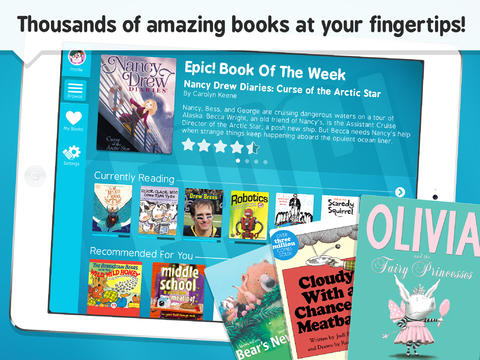
Check out Epic!- Books for Kids (FREE), an eBook library of picture and chapter books that can be used to present language-enhancing books in interactions with your students. Epic! offers thousands of narrative and expository books from major publishers such as HarperCollins, Scholastic and National Geographic. The app/website offers features facilitating an engaging presentation of a book to a group of students via an iPad, including zoom in/out to page and "read to me" audio available for some books.
Be sure to register for an educator account, which you can do through the website (there is also an app but in tele you would want to use the site for simplicity)
Epic! features a number of books I have used for language development over the years, and I have been finding other great options through the app. For example, the books Scaredy Squirrel and Scaredy Squirrel Makes a Friend by Melanie Watt offer the following "Speechie" book features:
-A narrative structure featuring problem, reaction (or attempts to solve) and conclusion
-Many expository elements presented in an engaging, fun way, e.g. animals Squirrel is afraid will bite him, sequences and connections between items and their functions.
-Text features such as diagrams and flowcharts that are helpful for scaffolding understanding (and seen in textbooks that students must grapple with in their classrooms)
-Contexts to explore social cognition strategies such as Zones of Regulation and the CBT paradigm of risk vs. opportunity (i.e. reframing anxiety-producing situations as opportunities to learn).
-Potential to screen-shot illustrations and pair with Strip Designer to make comic strip conversations about the character's thoughts and perspectives.
In my presentations on this topic I often include this reference that is very on point regarding the utility of this app:
The act of reading books aloud interactively and using scaffolding to support children’s use of more advanced syntax, vocabulary and critical thinking is itself an activity which addresses language development (Beed, Hawkins, & Roller, 1991).
Recently I was trying to get a copy of a book, Sally Gets A Job, that would align with a vocabulary set from one of my favorite apps, WWP-Vocabulary. The set featured good Tier-2 words such as skill, operate, career, successful, earn. Sally, dog hero of one of my favorite series, seemed a great match.
A quick search on Boston Public Library's website revealed that the book was right at my fingertips, free, via their connection to Hoopla, an electronic media service. Hoopla allows you to view books on a laptop or your iPad after signing in through your public library, if this service is offered to you locally.
So, this is just a suggestion to check out your library website's resources for picture book therapy materials. They may vary, of course (mine has connections to lots of picture and other books through Overdrive, but not Tumblebooks, which you may have), but probably offer you some great options of free materials!
Also, don't forget, EPIC! Books for Kids has scads of picture books, free for educators.
In the last post, I talked about how context can be your friend, not only in planning activities and engaging students, but also clinically. Incorporating curriculum topics is a key strategy for clinicians, but we need not be arbitrary about it. Please take these examples of contextual work as exactly that- examples. You can find out from teachers what they are working on and perhaps offer students a choice of topics to "roll with," especially if you are working on social objectives.
One tool I use frequently when making decisions as a group is the Levels of Like chart, a strategy I learned about from SLP Jenny Sojat. You can make one of these on a board to explore sample topics; it's also a good way to use Pic Collage:
Use Text tool to add the levels. Use the Web Image tool to search for images related to options being discussed. Poll students on their "thoughts" (good entry to perspective taking) and where each option lies. Try not to decide on something that anyone has below the OK level.
Let's say you explore pets as a topic. Pets are a nice entry point to curriculum as they relate to social studies (human interaction with environment, etc) and a number of science topics such as describing animal features, habitats etc. Some examples if you settle on, say, cats. Cats are cool!
Memes: A meme is, in internet parlance, something that is shared, often for humor. Memes are essentially narratives and often take on a "same but different" theme with different versions of a meme. But animal memes are usually a story, so think narrative language. Be careful where you get your memes; you can save images from icanhazcheeseburger, find cute groups related to animals on Facebook, or search for kid-friendly memes. You can organize them for presentation in a Google Slides format like I did below:
Note that each one is a (partial) story involving observation and prediction.
Character: owner and cat
Setting: bathtub
Initiating event: The owner is taking a bath WHEN the cat comes to visit and perch on the faucet
Sequential events/reactions: you guess
Also a good figurative language term in slide 1.
Books: Pets feature in a ton of narrative/expository picture books. Try Creature Features or It's all about ME-ow, which have science and social extensions.
Apps: Lots of apps revolve around pets. Many are not great! But check out Toca Life: Pets to tell stories and play (also great for categories/following directions), and apps like How to Draw a Cat Step By Step are good contexts for following directions.
Videos: Phrasal Verbs Friends is a series of fun cat vids teaching about Phrasal Verbs (basically figurative language). Thanks FreeTech4Teachers for that suggestion. Also see the Simon's Cat series for wordless narratives.
More Academic: see what BrainPop, NewsELA or EPIC! Books have for material on cats and teach expository text structures and strategies.
Context helps us achieve flow in our work, both in our own and students' enjoyment of it, as well as ease of planning. A study by Gillam, Gillam and Reece (2012) also found context linked to EBP, with improvements in sentence and discourse formulation measures when "clinicians treated multiple linguistic targets using meaningful activities with high levels of topic continuity." What contexts you pick are up to you, but I have one suggestion to start: the playground and recess. A couple ideas in this flow: Scratch Jr.
This free resource from MIT Media Lab is available as an iPad app or on Chromebooks. Coding is basically language teaching, a context for us to help students follow directions, work with characters and settings, and describe movements that result. It is also a big causal (because/so) and conditional (if/then) context. Scratch Jr. provides mini-curriculums including one allowing you to simulate playground games! The teaching guides here can be modified by taking a screenshot of the key directions, like so:
Tells you what to do...
Shows your students what to do
Not so complicated, and very fun!
Practice Playground Games
Make visual supports via Comic Strip Conversations (with marker and whiteboard or Doodle Buddy/Book Creator) and practice playing active games. This will give your students many language opportunities and also be skill-building activities for actual recess.
Pair with Picture Books about Recess
Try The Recess Queen (O'Neill) or Do Not Bring Your Dragon to Recess (Gassman), both providing context for social and narrative teaching opportunities. Psst: find read-aloud video versions on YouTube.
Playground Physics
For upper elementary students, try this free app from the series of "Noticing Tools" from the New York Hall of Science. You can video students running or doing playground actions and measure speed and various scientific measures. Lots of narrative and expository language can ensue, as well as being a social context of moving to an outdoor space together and observing ("body in the group").
Also consider that a good chunk of the fun and instructive Zones of Regulation: Exploring Emotions app plays out in a playground setting, exploring how daily events change our zones and prompt us to use tools to regulate ourselves.
I'm sure you can think of many other activities going with this context, tech-related or not! Please let us know in the comments if you do.
The Internet loves a "Fail," which Urban Dictionary defines as [noun, in this case] "a glorious lack of success." From a narrative standpoint, however, a fail is an initiating event, a critical story element to work with in our students' language. Graphic organizers reduce cognitive load and help students identify and internalize narrative structure, which assists with comprehension and production of narrative language. One level I like to work with my students around is the Reaction Sequence, which looks like:
Character
Setting
Initiating Event
Reaction (what the person DOES in response to the IE, note that this is not a Response or Feeling, which is part of the next level of narrative development, often called the Abbreviated Episode)
The Reaction Sequence is sometimes represented as Somebody Wanted But So. You can use SWBS, Story Grammar Marker®, Story Champs, or other approaches such as the Gillams' SKILL for your graphic organizers, or make your own. Good idea to have some sort of consistency in the icons or GOs you use, however.
So, the tech part: humor is great in therapy, but be careful about where you get your fails. I like America's Funniest Home Videos (AFV) as it is super family-friendly. Take this video compliation:
It provides a great 15-30 min activity in having students formulate the narrative of what they see. Of course, use the pause button, and a few other ideas
-Zoom in on character, some students have a difficult time reading nonverbal signals around age and relationship between people (a skill measured in assessments like the Social Thinking® Dynamic Assessment Protocol). Scaffold statements like "a brother and sister" or "a kid who is probably like, 8 years old."
-NOTE that with the above you are working on microstructure such as noun phrases and use of conjunctions (also linking between the story elements: "A group of kids is surfing at a beach WHEN a huge wave comes.")
-Zoom in on setting, many of my students would just say "outside"- scaffold specificity such as a beach, a lake, a hiking trail, and so on.
-Consider adding a pragmatic element with an ersatz barrier task- one student can watch and narrate, then show the video to the group.
I have previously mentioned here and here that coding activities, though designed for computer science and educational initiatives such as Hour of Code, have a lot of language underpinnings. They are engaging contexts to have students practice following directions, learn vocabulary, and use causal and conditional language in their verbal (or written) interactions. These activities are also great for "Group Plan" work (see Social Thinking®).
Additionally, I wrote about the idea of "flirting" with contexts that you really don't want to get deeply into. Minecraft is one example; kids find it very engaging but playing the actual game is something I don't have time to figure out, and may be hard to structure for efficient use of therapy time. In these cases I might use something defined that is related to the context, such as a video clip that might prompt narrative language.
As in the other coding resources I have highlighted, Code.org provides an easy to use, non technical interface. Intro videos set the context and provide directions, as well as a context for students to practice stating main ideas and the overall plan. Check out the Minecraft activity page- the Voyage Aquatic and Adventurer activities are great places to start, asking students to assemble series of blocks to move and perform simple actions. Code.org can be used without sign-in, but if you create a free account, it will save your progress. The website works on full web browsers (Mac/PC/Chromebook) or in the iPad Safari browser. You can also explore their activities from other contexts, such as "dance parties" incorporating music and app creators.
Presenting a video can be a simple use of tech that can establish context, provide visual support, engage students in discussion, and open the door to a related post-activity addressing language skills. A good example is this video which features about 100 unnecessary signs such as:
The video moves quickly, but pause as many times as you want! You can also screenshot to pick and choose signs you'd like to explore (perhaps a good move to work on functional reading). Some ideas on using the video:
-Metalinguistics: what makes the message obvious and unnecessary?
-Social Cognition: the video can be used to have students practice "thinking with their eyes" for the greater context of what makes the sign silly, as well as engaging in humor. Using signs in therapy activities is also a good way to introduce the related Social Thinking® concept of "Hidden Rules" (related to Dr. Brenda Smith Myles' Hidden Curriculum); there are many (more complex than shown here) rules that we need to learn through observation and experience in order to be successful socially.
-Narrative Language: Have students discuss or sketch stories depicting why someone thought these particular signs were necessary. This context would also allow for working on complex language and conjunctions like if, because, and so.
ASHA Convention was quite a production in Los Angeles this past week. I wanted to share a few snippets from my own presentations as well as some tech tie-ins from others', so I will be posting those over the next week or so.
My session Setting up the Sequel: Pairing Picture Book Series & Apps to Contextually Address Language Objectives focused on using picture book series along with apps for pre- or post-book activities. One key idea is that we can use narrative teaching strategies and other language scaffolds in the process of using both books and apps.
I presented some ideas about working in context within interventions, including the following:
Context allows for easier planning and semantically/narratively deeper intervention.
Contextualized language intervention is supported by studies such as (Gillam et al, 2012): “signs of efficacy in an intervention approach in which clinicians treated multiple linguistic targets using meaningful activities with high levels of topic continuity.”
SLPs should maintain “therapeutic focus” (build skills and strategies) within meaningful context- book series are one way to approach this (Ukrainetz, 2007, Ehren, 2000).
We can analyze series for characteristics between books (or apps) that lend themselves to language interventions.
One series I reviewed was the Sally sequels (by Huneck, available with your free educator account in the app/website Epic! Books for Kids. The "Speechie" characteristics of this series include that they are simple narrative action sequences that can also be told at higher levels of narrative (see stage model in this article and this figure), they include many different settings, figurative language, and opportunities to scaffold cognitive verbs--Sally the dog "thinks about" many different things, decides, realizes, discovers and so on. Books like these that give many openings to language elicitation--where the illustration might prompt more verbalization to go beyond what the text states--are also good therapy tools. In the same way, apps that have language-neutral visuals without a lot of talking or noise are good candidates for our use. Take the Toca Life series (with a Farm, Vacation, School, Office, City and Town, Stable and Hospital) as one that has embedded language opportunities with categories in each scene, opportunities to demonstrate actions and create stories.
Toca Life: City pairs well with Sally Discovers New York (Huneck)
An additional main point of this session is that stories can be told in many different ways (see the developmental sequence link above) and found almost anywhere. Since we were in Hollywood and talking sequels I provided a tie-in to "bad" sequels and analyzed them with different narrative forms. Check out this "climactic" (strangely boring and seeming to affect only the 10 people they cast in the film) clip from Speed 2, and an analysis via Story Grammar Marker's 6 Second Story™, which we can use to scaffold a kernel of conversation:
Consider therefore how we can use different levels of narrative development to scaffold elaboration using fun and motivating contexts such as film clips as well.
Gillam, S. L., Gillam, R. B., Reece, K., Nippold, M., & Schneider, P. (2012). Language Outcomes of Contextualized and Decontextualized Language Intervention: Results of an Early Efficacy Study. Language, Speech & Hearing Services In Schools, 43(3), 276-291. doi:10.1044/0161-1461(2011/11-0022)
Ukrainetz, T. A. (2007). Contextualized language intervention: Scaffolding PreK-12 literacy achievement. Pro-ed.
Ehren, B. J. (2000). Maintaining a Therapeutic Focus and Sharing Responsibility for Student Success: Keys to In-Classroom Speech-Language Services. Language, Speech & Hearing Services In Schools, 31(3), 219-229. doi: 10.1044/0161-1461.3103.219.
News articles serve a number of purposes in speech and language interventions:
-context for use of graphic organizers teaching narrative or expository language structures
-opportunity to pose questions and elicit discussion with use of discussion webs (see Hoggan and Strong's mention of discussion webs as a narrative teaching strategy)
-newsela is geared around "text sets" and themes as well as daily news, and also allows you to change the reading level of each article
-within each article is scaled vocabulary known as "Power Words"- these are presented with student-friendly definitions that align with Isabel Beck et al's recommendations for building robust vocabulary.
-presenting this material digitally will add a level of engagement; newsela integrates nicely with Google Classroom.
One of the resources that has been helping me read more is Goodreads, a database of books and reviews. Goodreads integrates well with your Facebook account, and this is helpful both for pulling in friends and seeing what they are reading, and allowing you to post to Facebook about your own books. It creates kind of a positive peer pressure for reading, and this makes Goodreads a helpful tool for us, and potentially for clients as well. Encouraging clients to use Goodreads to find books similar to what they have enjoyed could potentially get them to read more, and also be an outlet to help them write about what they have read. A few other features of Goodreads that I enjoy:
-The mobile app is excellent, and in fact a little better than the website itself.
-Goodreads allows you to mark books as "Want to Read" and this is a good place to keep a list of this kind when you encounter book recommendations, preventing you from getting "stuck."
-The site provides recommendations based on what you have read and how you have star-reviewed books.
-It integrates with the Overdrive-Kindle connection (mentioned in my last post) so what you are reading through there is automatically added to your "Currently Reading." There are other features such as a Chrome extension that allows you to see which of your To-Read books are currently available on Overdrive.
I think of reading as being similar to mindfulness (also in some circles a tool within speech-language pathology)-- in order to teach it, you have to be at least a little bit in the practice of it.
I realized some months ago that I wasn't reading as much as I used to read. This made me a bit ashamed and sad. I was an English and journalism major, for God's sake!
There were a few reasons why I had fallen into somewhat of a reading rut:
-I've become more of a minimalist and I feel I have enough books around the house. At this point, I'm not interested in adding more stuff.
-I know many love the feel and smell of books, but I am not necessarily enamored of physical books. Partly, there's the complications of reading in bed with the other half and not wanting the movement and light to be an issue.
-Given the above two factors, I had begun to convince myself that I can effectively continue as a reader using my iPad and iPhone. The night mode features of reading apps were particularly attractive here. Problem is...I didn't. The availability of other apps besides iBooks and Kindle just made too much of a distraction. Also, just try reading on one of these devices in sunlight?
-I had also immersed myself in informational reading and thought that fiction just wasn't really for me anymore. The issue here is that nonfiction books tend not to propel you forward as much as a good story.
Coming to a solution around these issues required me to think about several things:
1. Reading has many benefits personally as well as professionally, with studies demonstrating its connection to mindfulness itself (as someone who struggles with a touch of anxiety) and also emotional intelligence and empathy.
2. Pick the right tech tool for the right task.
So, since my technology was failing me, or I was failing within it, I bought a Kindle.
This might seem an overly simplistic conclusion, but this simple device pretty much solved my reading problem. My Kindle Paperwhite (bought refurbished from Amazon, incidentally) feels great in my hand, has an attractive look and interface, and it does what it does. I started Wild on April 9, and including that, have finished 8 books since then! And 2 audiobooks (via my iPhone)!
I have enjoyed all this immensely--well not always, I picked a few clunkers--and have felt some important cognitive-linguistic processes being awakened, as well as the mindfulness factor.
If I can leave you with another tech tip, minimalism also attracted me to the use of Overdrive and my local library card. Overdrive works wonderfully with Kindle as you can "download" as a Kindle book (via the Overdrive app or website) and your Kindle device will auto-sync when on wifi and pick up that book- you only have two weeks though, so read (or listen- this is how I did my audiobooks too) fast!
SpeechTechie is my take on simple and interactive technologies you can use in language lessons and interventions. Enjoy!
Interested in learning more? I am available to conduct professional development sessions, including via webinar. If you'd like to work with me to design a presentation or consultation for your school or organization, please check out the "Work with Sean" page on this website.
Sean is a MedBridge instructor for several courses (avail. Feb 2018). Click to join MedBridge at a discounted rate for high-quality online PD and CEUs. A wide variety of courses are available for SLPs.
Visit and "Like" our Facebook Page
Follow SpeechTechie on Twitter for updates!
Thanks, Guys!
Click on the badge to explore a ton of great blogs!