Proceeding from some ideas about the role of music in speech-language therapy (and social coaching), back in the spring I did some activities with MusicLM. This tool is available from Google's AI Test Kitchen, which is free, though you currently have to sign in with a personal Google account and may have to wait a short while to be approved. With Music LM you "Describe a musical idea and hear it come to life." More specifically, type an activity, setting, situation, style, mood, or specific musical instruments, and it will create several examples for you.
The language and/or social interaction can come in through providing schema with the above italicized connections to music, using this as a conversational "add a thought" type activity, and allowing flexibility- as maybe your clients will think of possibilities that fall out of these categories. You can also be more structured and gear a lesson around, say, emotional vocabulary.
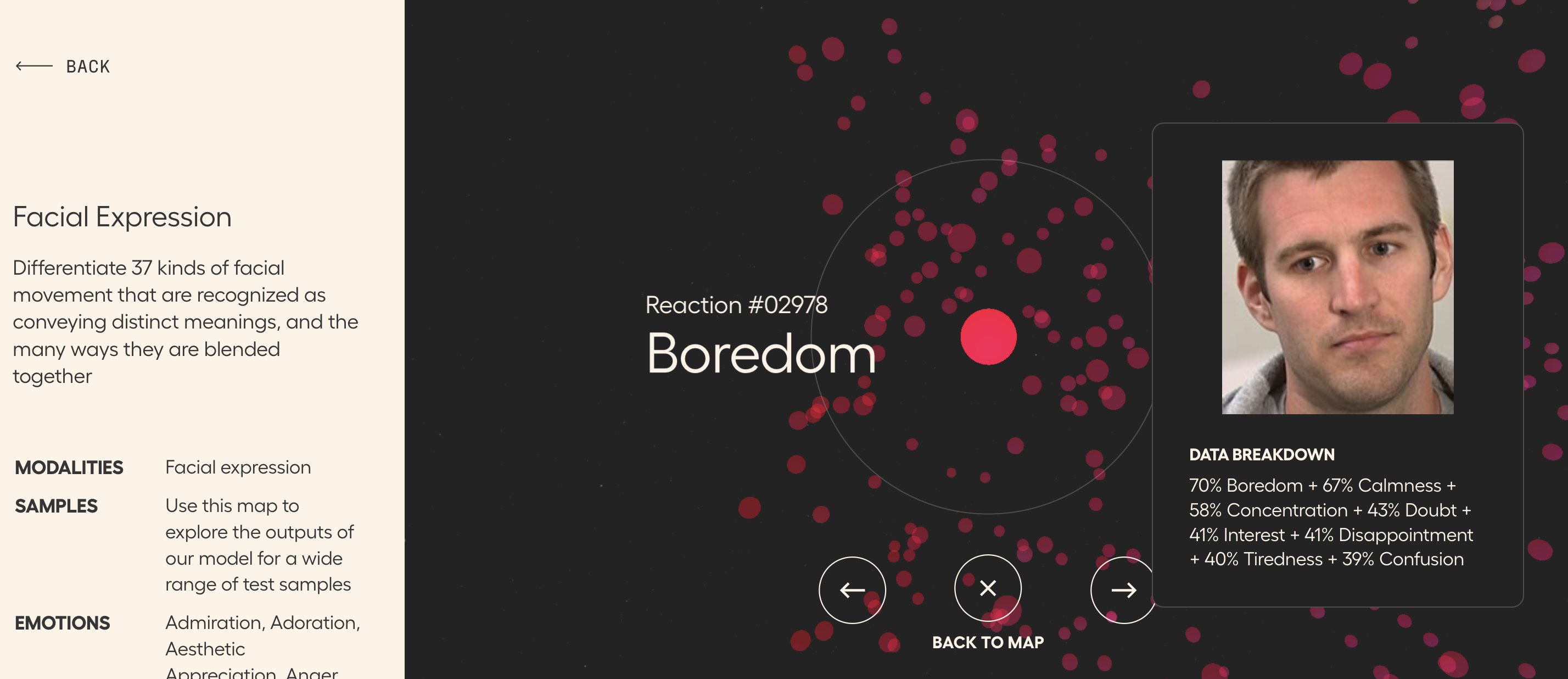
Check out Hume AI's website for a number of maps of various types of nonverbals that may be useful to you in therapy activities, particularly with teens, young adults or adults. I say that because some of the content on the website-- particularly the expressive language map-- is more mature.
I'd suggest starting with the facial expression "galaxy" as I labeled it with students. Click within a cluster and explore nearby facial expression to discuss, for example, what makes surprised look surprised, in terms of what the face is doing.
Scroll down on the main site and you'll see other datasets such as Emotional Speech, "Recordings of sentences being spoken in dozens of emotional intonations around the world"
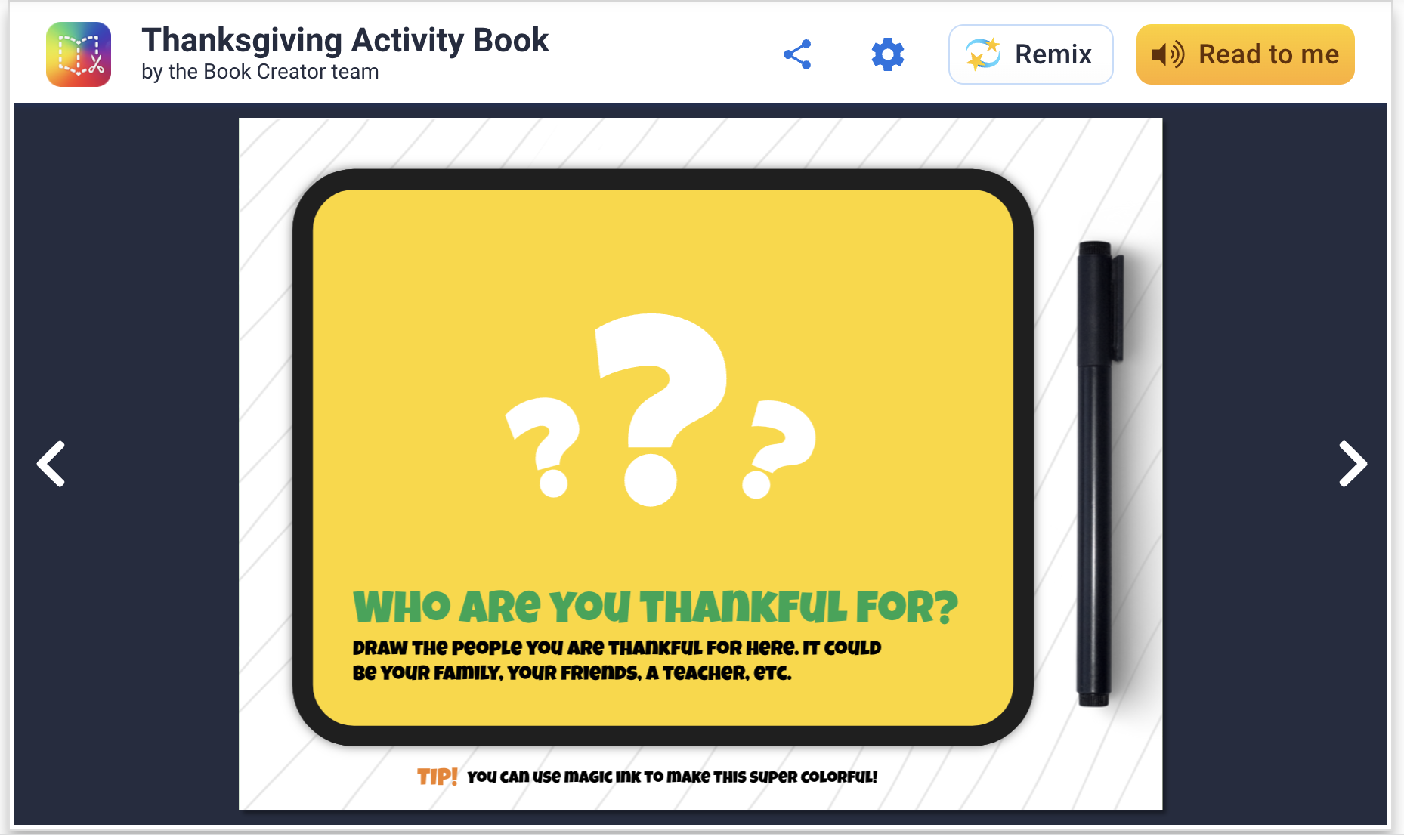
Book Creator has long been a stellar app/webtool and recently I discovered that they have templates to "remix." You can add templates to your app and do a collaborative work on your iPad among students, or if in a Chromebook environment your free account will allow you to share with students' Google accounts easily. This is an attractive option because, well, they are attractive and you don't have to design the book yourself. Richard Byrne describes the magic ink and autodraw features here.
These "activity books" are filled with language underpinnings like storytelling opportunities, semantic knowledge and vocabulary. You can easily copy and modify any page to cater to your students before starting the activity. For example, on this page below, you can zoom in on a map and have kids in the group find out where others live (generally) for spatial/academic/biographical knowledge of others. Additionally, with this template, gratitude is literally good for your brain to practice all year long.
ASHA Convention was different, but it happened! Thanks to all the organizers for providing a safe and very educational event. I was honored to present on Thursday to a great in-person crowd.
The focus of the session was on "playful" activities for language and social interventions across the age levels.
A few resources I presented:
Improv games are supported in our literature and mirror the format and communicative behaviors of conversation. Be sure to teach the nuance of "yes, and..." and couple with lessons on when we say no, and that it is OK to disagree (avoid ableism and support neurodiversity)..
Books are their own therapy tool and give you great ideas for playful followups. In this case Spencer's New Pet gives lots of opportunity for nonverbal situational interpretation and narrative development. (see this post for tips on using Youtube to present picture books). Balloon Animals! app made a nice pairing for a playful post activity here, following a quick lesson to pre-load some social strategies. See my free booklet on Pairing Picture Books with Apps!
You can use game contexts (e.g. Minecraft, Pokemon) without ever actually playing those games. A recent example: I have been leveraging a student's interest in Pokemon to use Pokemon Adventure comics (available via my public library on Overdrive which exports to the Kindle app) for nonverbal and emotional interpretation, narrative retell, and identifying and working with vocabulary. The vocabulary words need not be in the text to be relevant and motivating!
I'll wrap up Consider This with an example from this week. I have a student who is a Red Sox fanatic (a husband too) and they are of course in the playoffs. This story surfaced and has a lot of nuance to it, with targets regarding story grammar, perspective taking (which is really just story grammar times 2, 3, or however many people are involved), figurative language and body language. For brevity's sake I'll let you check out the link and the couple of videos there for the context.
This is the kind of scaffolded discussion that could take place via telepractice or in person, but I happen to be working with this student online. Zoom's annotation tools are a bit clunky (easy to click off your text box and need to make another, you scroll down on a webpage and they stay in the same place), but did the trick. If this annotation drives you nuts, it's an easy shift to Google Slides to toggle between tabs and use your preferred story grammar frame. In this case we just took some notes as we discussed; it's almost always better to provide visual support, which aids in working memory, processing, and further formulation.
Not to alienate any Astros fans, we did go on to note Correa's response to the incident was pretty positive, though there may be some nuance there too.
To go from the specific to more general, using current events can:
-activate students' interests
-provide contexts for story and expository text structure (and microstructure: sentence formulation and vocabulary)
-within the former, open doors to targeting social cognition, emotional vocabulary, or Zones®
My biggest trick in this regard has been keeping up with news myself, listening to the local news radio station, NPR, or subscribing to digests from local news sources to skim. As I've mentioned before, newsela is also a great go-to. I also have a student who loves CNN 10, a video resource.
The 2020 Comedy Wildlife Photo Awards finalists were announced recently, a development I saw on the news (you never know where you will get therapy ideas). Based on the BBC story about the awards, I found 4 or 5 photos that made for great therapy activities. For example, I used this one...
...with a high school group in Google Slides as a way to review the concept of thinking with the eyes (Social Thinking®) but also as a review of Zones of Regulation®, starting with the Blue Zone (well, going whole-part-whole as is often recommended for teaching schemes like this). Interestingly, the order of details written here is in order of how the group members processed the picture. Again, this serves as a reminder that Google Slides makes a damn good therapy tool as a multimedia flipchart.
Following this, I discovered that the Comedy Wildlife Photo Awards website itself is a goldmine, containing past winners and years of finalists. As you likely know a right click on any image gets you a fair-use-copyable for educational activities, but don't republish any images, especially not for commercial use. Be aware also that you will want to screenshot or save images rather than free-exploring the site itself with students. Wildlife occasionally flips the bird or engages in other inappropriate behavior.
In a terrific recent PD I watched, Rachel Madel made a great point: why use static photos or drawings to demonstrate verbs, when we have GIFs. GIFs (arguably pronounced with a soft "g" or like the peanut butter) are a format that shows photos or cartoons as a short looping video. Like this:
The weather today in Boston got me like...
As Rachel said, GIFs can be great for verbs but also:
-emotions
-basic narratives
-sentence formulation
-connection to curriculum
-concepts
-figurative language
-are simple stimuli that don't require much sustained attention
-and not least of all, are cool.
GIFs live best in Google Slides, which would give you a place to put them in a flow of context, and you can place them next to typeable space for formulating and visually supporting language.
GIPHY is a great place to get GIFs. To put one in Slides, search for what you would like, select it and click through to it. Click Copy Link and copy the FULL link. Back in Google Slides Insert>Image> By URL. Click to select the image and click INSERT.
One of my students in a group session this week shared as his "low" that he is upset by all that is going on with racism and injustice in America and that "it's another layer on top of the layers the country has been dealing with." A wise way to put it.
I'm working on what I can do in my own community, but I wanted to work to elevate black voices in my sessions this week, in ways that might help my students process current events and also be goal-oriented. A conversation about race is about many things, but partly thoughts and perspectives and experiences, all wrapped up in narrative language. Experiences start with the landscape of action (Bruner, 1986) or ability to describe actions in the story as well as character and setting, but relate to the higher level landscape of consciousness/theory of mind ability to describe thoughts, feelings, plans and perspectives related to these events. Cognitive verbs such as think, know, remember, realize, guess also often form complex sentences as in I thought I should do something to help.
For a group of 4th-5th graders this week I read from Can I Touch Your Hair? Poems of Race, Mistakes And Friendship available on Epic! Books, reviewed here by Kirkus Reviews. The poems have a white and black student each reflect on planned topics for a poetry project, in the process sharing stories and embedded "thoughts" that often require some inferencing. I read the book in part and then made it available in the students' free remote access library available through Epic! As a post-activity we completed a discussion web of sorts with the students' contributing their understanding of some of the characters' thoughts as extracted from the narratives. The thought bubble visual is from Story Grammar Marker® and available in their downloadable icon products. (Note: Author has a contractual consultative relationship with Mindwing Concepts for provision of blog and presentation content, but receives no royalties should you buy their products) Typable thought bubbles as always are available through Google Slides in the shapes>callouts menu.
I was happy to see that this book was included in Epic!'s Start a Conversation about Race collection- if you are looking for material over this time.
And to make it absolutely clear, #blacklivesmatter, this week and every week.
Comics are motivating therapy tools that can be used to develop a narrative, work on physical description, emotional vocabulary, interpretation of nonverbals, or social behaviors and conversational moves. Pixton EDU provides much for free currently and as a webtool is very applicable to teletherapy. You can see some of my previous posts on Pixton here and here but in the video below I demo the current upgraded Pixton EDU. Email subscribers can click here for the video.
Given the current crisis and stay-at-home advisory (now transitioning to a safer-at-home advisory in MA) I have been focusing in groups on narrative, conversations, and social self-regulation tools. A few books that have opened up to discussion and followup activities (Recall that EPIC! offers free educator accounts):
Sergio Sees the Good- this book is about negative bias, how we tend to notice and react more to negative things than positive. Good for a narrative activity after where students list positive things about their week, even "everyday positives" like a comfy bed.
Dictionary for a Better World- this book is useful over multiple sessions, has abstract vocabulary and challenges you can revisit with students for narrative or journaling.
I tried out Loom to show you some recent books I have used in teletherapy and a simple game that can be used for social and language targets in multiple teleconference platforms (i.e. through screen share or through remote cursor control). Email subscribers click through to see the post or see the video here.
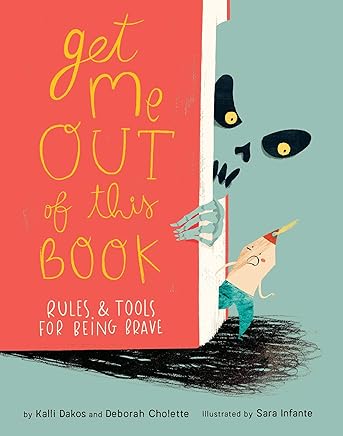
Hi folks- Online sessions continue to go well! -Managing fear/anxiety: We read and discussed a fun, engaging book - Get Me Out of This Book: Rules and Tools for Being Brave. Here's the vid if you want to review with your child and fam- we went page by page with me reading on EPIC! Books for kids: watch the video
We first talked about how we have learned about tools through Zones of Regulation®- -A Blue Zone tool perks us up if we are bored, sad, sick -A Green Zone tool keeps us in the green zone, feeling calm, happy, ok -A Yellow or Red zone tool calms if we are anxious or very afraid -And a tool can be an object, action or thought In the book a Bookmark (a wacky character like this is fun) gets anxious because of scary content in books, like pages with snakes or sharks. He learns three strategies: -breathe -make a plan -think a good thought I discussed with the boys that learning that you can change your thinking is a lifelong lesson. I have had to use these strategies constantly and I talked about how I had to coach my own mom (in her 70s now) when she sent me some worried texts recently. The boys understood why this discussion was important currently. The book makes clear in a note at the end that these three strategies are ones learned by Navy SEALs!...
Some notes:
-An almost middle-schooler in this group is often overly concerned/critical of materials being babyish when they are not, and appeared to enjoy the book thoroughly.
-Reading books interactively is a great activity for teletherapy
-If you don't already know about EPIC! it is a free (for educators, always) e-reading library. The book in question is here.
-This book could make a great story grammar map. It is also an example of metalinguistics, talking about elements of stories, and a kind of metanarrative (a story being aware that it's a story).
In these extremely difficult times, we need all the tools to keep ourselves Calm. Calm (available also as apps for everything including Apple TV, as you see below) has free visual "scenes" with environmental audio. Try it and zone out for a few minutes. Calm also could be a nice regulating entry to any telepractice session, or a narrative activity, if you screen-share a scene from the website (log in, click on scenes, choose a scene, turn audio on, click home, click on screen to make menu go away).
I'm reposting this now because people could use ideas for videos that set contexts in telepractice sessions. These are all great social cog/self-regulation videos and could also be used for language lessons- for example story grammar or sentence formulation, or compare-contrast to the inspiration stories for the videos.
Sesame Street has been on a self-regulation initiative for the last several years. A series of skits called Cookie's Crumby Pictures parody popular movies and model strategies for listening, recalling directions, waiting one's turn and self-control. Children would not get the references to Karate Kid or When Harry Met Sally, but find the videos entertaining nevertheless. You can even sell them to older kids with a little effort. As always, a video that covers a social-emotional concept in the context of a story offers both a social cognition and narrative teaching opportunity. Check out this full playlist here, and a few sample videos are embedded below (email subscribers, click through to the full post).
Whole Body Listening:
"Thinking with the Eyes" (see Social Thinking®) and Problem Solving:
This past week I noticed that I started this website 10 years ago (2/24/10). Time flies! I am grateful to all who have read it over the years, and for the opportunities it has provided me: opening doors to many friendships, presenting around the country (and Canada), many trips to ASHA Conventions, and publications there and elsewhere. Thanks everyone!
Of that decade, by far the simple but eminently useful app Pic Collage (free for iOS, Android, Windows) has been my favorite. I recall the day the awesome Sarah Ward showed it to me. It is a great resource for SLPs to make quick visual supports and to co-create with students. Here are 10 things you can do with Pic Collage:
Make a vocabulary board. Note that the Web Image Search makes this a very quick process to do with students (they can choose pictures associated well with vocab words (BING Search is nicely restricted)
Play! Play is about adding thoughts and ideas (see Social Thinking®'s We Thinkers). Here we decorated a treasure chest. Hands-on is great too but sometimes you may be lacking in materials or time. Note that any picture added by Web Image can then be double tapped to "Cutout."
More related to We Thinkers and Story Grammar Marker®- explore what different characters think about, you are therefore relating story events.
Make "Colorforms" from photos to retell/act out a story with dramatic play. In this case Gilbert Goldfish Wants a Pet.
Visualize to scaffold students' personal narrative. In this case we talked about how setting linked to actions and events.
Set the stage for cooperative play with yet another cooperative activity. These students created a sign before playing Lemonade Stand on the Echo Dot.
Target emotional vocabulary based on the 6 universal feelings (happy, sad, mad, scared, disgusted, suprprised). These high school students passed Pic Collage and added to kinds of angry (relate to Zones of Regulation®) after watching a Star Wars clip.
Create any kind of story. Here, setting, initiating event and reaction are visualized.
Use dual-focus vocabulary strategies (semantic and structural per Diane German).
Make curriculum language and categories more salient and visual. In this case a consumer science class was covering "ways to pay."
Make comics showing triggers/initiating events and use of tools and strategies such as self-talk.
Show circular sequences. Think of doing the same for Numeroff's If you Give... series.
OK, that's 12 instead of 10 but I couldn't decide which to share!
Sesame Street has been on a self-regulation initiative for the last several years. A series of skits called Cookie's Crumby Pictures parody popular movies and model strategies for listening, recalling directions, waiting one's turn and self-control. Children would not get the references to Karate Kid or When Harry Met Sally, but find the videos entertaining nevertheless. You can even sell them to older kids with a little effort. As always, a video that covers a social-emotional concept in the context of a story offers both a social cognition and narrative teaching opportunity. Check out this full playlist here, and a few sample videos are embedded below (email subscribers, click through to the full post).
Whole Body Listening:
"Thinking with the Eyes" (see Social Thinking®) and Problem Solving:
Plotagon Story is a very useful app for iPad and Android (free) that is now also available to download for Mac or PC. Plotagon represents the type of creative app that allows us to create models of concepts, skills or narratives, but also then to use as a co-creation tool so students can apply their understanding while having fun. With Plotagon, you choose a scene (many available for free) and create or use characters, then can type in a dialogue between them (2 characters only). You also can add emotional reactions; see my post walking through Plotagon in relation to the 6 Universal Feelings and Mindwing's Story Grammar Marker® (including a printable visual) here.
For another specific example of a clinical use of Plotagon, consider the Peers® Curriculum, which includes a breakdown of strategies in "trading information" in conversation. One of these includes the twofold moves of asking questions and then answering your own questions (basically topically commenting). In providing an overview of these moves week by week with a group of teens, Plotagon was useful in providing an engaging visual example before practicing the moves in conversation. Here's an example (this took me all of 5 minutes to make).
Breathing is an important tool that SLPs can employ in a variety of client populations. For our students with self-regulation difficulties, having tools they can use anywhere without disruption of the current situation they are in can be very important (see Zones). For us, too-- our jobs can be stressful, whether it is a difficult treatment situation, a contentious IEP meeting, or just going back to work after the summer (I AM STILL NOT REALLY READY)...we need tools.
I've always found any kind of mindful breathing to be useful, but this summer I stumbled upon a link from VICE News that led to some interesting science. One study sited here documents the effects of "coherent breathing" at a rate that balances the sympathetic and parasympathetic nervous systems, leading to increased calm for people with varied conditions: "In subjects with MDD (major depressive disorder) treated with resonant breathing (coherent breathing with pursed lips resistive exhalation) at 4.5–6.5 breaths per minute (bpm), HRV (heart rate variability) increased and mood improved." Part of the technique is that one should avoid counting, say to 6, as that engages the sympathetic side too much.
I was easily able to find an app that therefore provided other cues so that breaths could be timed to correspond with the BPM guideline: The Breathing App (free for iOS). I have used this as a warm up for groups and also frequently for myself. The app provides different modes: in one, a ball enlarges as a visual for inhalation timing, and decreases in size for exhalation. I have found especially useful another mode which uses audio tones of different notes to time the same--great to use in the car when feeling just a tad anxious on the way to some work task. Check it out and try the technique!
In my last post, I discussed how some Star Wars conversation led a group of mine to some engaging self-regulation activities incorporating movement. I always like extending themes, and observe that both watching short videos and, for some reason, watching me type into a presentation slide both get kids talking! I found a Star Wars template easily and we used this "blank space" to map out some social narratives related to play, thinking, self-talk and regulation, and social cognition after reviewing some short videos.
I feigned some blanks in my knowledge and together we summarized that:
Character: Obi Wan
Setting: Tattoine
Initiating Event: The Rebels have put plans for the Death Star, which show how to destroy it, on R2-D2. The stormtroopers stop the group and want identification
Response: Calm
Plan: Get past the stormtroopers
Action: Uses a Jedi Mind Trick to get past
Conclusion: They continue on their mission
The narrative could also be flipped and analyzed from Luke's perspective, who at this point is mystified by Obi Wan's powers.
In addition to talking through the narrative elements, focusing on cause-effect relationships, we also talked about the theme of Jedi Mind Tricks as a way to talk about changing thoughts of ourselves and others (awareness of self-talk) in both pretend and real ways (see above re: simple uses of PowerPoint, Google Slides or Keynote for visual support):
We also role-played JMTs just for fun and playfulness.
Follow-ups! Contexts that get kids talking and thinking about concepts, skills and strategies are always worth repeating, so see also:
Stop, Breathe and Think Kids is a great free app that promotes age-appropriate mindfulness through video and play-based "missions." These can be a great way to start a session with youngsters and promote "portable" strategies/tools related to the Zones of Regulation®. The videos are also contextual, based in characters, settings and actions, so can be used in conjunction with narrative teaching strategies. The "Find a Mission" option in the app aligns a video with the students' current mood and emotion, thus allowing for teaching of feelings vocabulary. The app and its older brother Stop Breathe & Think, useful for older students, also offers a web app.
SpeechTechie is my take on simple and interactive technologies you can use in language lessons and interventions. Enjoy!
Interested in learning more? I am available to conduct professional development sessions, including via webinar. If you'd like to work with me to design a presentation or consultation for your school or organization, please check out the "Work with Sean" page on this website.
Sean is a MedBridge instructor for several courses (avail. Feb 2018). Click to join MedBridge at a discounted rate for high-quality online PD and CEUs. A wide variety of courses are available for SLPs.
Visit and "Like" our Facebook Page
Follow SpeechTechie on Twitter for updates!
Thanks, Guys!
Click on the badge to explore a ton of great blogs!