The movie Here comes out this week, reuniting Tom Hanks and Robin Wright with their Forrest Gump director Robert Zemekis. The movie is said to be experimental, with the camera fixed on one area to show a nonlinear story/stories that happen in a particular space across a broad range of time. Here is based on a comic and then graphic novel by Richard McGuire; both would be useful for reviewing with teens but the original comic is located, well, here. I could see this as useful for an activity in story mapping, BrainFraming (or other sequence graphic organizer), or timelining the events shown.
Showing posts with label nonverbals. Show all posts
Friday, November 1, 2024
Friday, November 26, 2021
ASHA Wrapup
ASHA Convention was different, but it happened! Thanks to all the organizers for providing a safe and very educational event. I was honored to present on Thursday to a great in-person crowd.
The focus of the session was on "playful" activities for language and social interventions across the age levels.
A few resources I presented:
Books are their own therapy tool and give you great ideas for playful followups. In this case Spencer's New Pet gives lots of opportunity for nonverbal situational interpretation and narrative development. (see this post for tips on using Youtube to present picture books). Balloon Animals! app made a nice pairing for a playful post activity here, following a quick lesson to pre-load some social strategies. See my free booklet on Pairing Picture Books with Apps!
You can use game contexts (e.g. Minecraft, Pokemon) without ever actually playing those games. A recent example: I have been leveraging a student's interest in Pokemon to use Pokemon Adventure comics (available via my public library on Overdrive which exports to the Kindle app) for nonverbal and emotional interpretation, narrative retell, and identifying and working with vocabulary. The vocabulary words need not be in the text to be relevant and motivating!
Hope you all had a great Thanksgiving!
Wednesday, May 20, 2020
Demonstration of Pixton EDU- simple comic creation in teletherapy
Comics are motivating therapy tools that can be used to develop a narrative, work on physical description, emotional vocabulary, interpretation of nonverbals, or social behaviors and conversational moves. Pixton EDU provides much for free currently and as a webtool is very applicable to teletherapy. You can see some of my previous posts on Pixton here and here but in the video below I demo the current upgraded Pixton EDU. Email subscribers can click here for the video.
Monday, May 4, 2020
May the 4th Be With You
You may not have time to incorporate this into today's sessions, but there's some generalizable ideas here anyway. May the 4th is of course the punny/meme-y Star Wars "holiday" when we can wish everyone all The Force. Using topics of interest to our students is motivating, especially in tough times, and can incorporate many goals around language. LEGO clips (Star Wars, Indiana Jones, Batman, Adventures, others) are widely available on YouTube and frequently wordless, thus tapping interpretation of nonverbals and situational cues.
Training is a fun such clip.
You can use this clip in teletherapy to:
-Work on narrating or composing sentences about the story
-Use chat to have students write lines of dialogue, working on conversational language (see Anna Vagin's ideas about this)
-Guide a discussion web about a question like "What's something you had to practice to get better at?"
Training is a fun such clip.
You can use this clip in teletherapy to:
-Work on narrating or composing sentences about the story
-Use chat to have students write lines of dialogue, working on conversational language (see Anna Vagin's ideas about this)
-Guide a discussion web about a question like "What's something you had to practice to get better at?"
Friday, March 27, 2020
Approaching "Whole Body Listening" is an important tool in teletherapy
After a week and a half doing telepractice with my groups, I notice one of the biggest lessons everyone is learning is regulating their body within the "group" meaning the Zoom Speaker View or Gallery View.
An anecdote on this is that I have a HS group with a client who has a lot of verbal stereotopy that is of course very difficult for him to control. As his first tele group was starting, this occured, and I was so proud of another client in the group who has really grown in his understanding of this peer. He said, "We can all just switch to Gallery View so that the camera doesn't pull to whose speaking as obviously." Just a great moment without shame. We then discussed as a group how to do this toggle and I made sure everyone could do it.
But Whole Body Listening is still "a tool, not a rule" as Suzanne Truesdale and Elizabeth Sautter have put it. We can gently encourage these behaviors while avoiding ableism or insisting that all make eye contact with the camera, or stay "still." There is, however, a difference between self-regulatory movements and behaviors and being disruptive on purpose or to seek attention, so we can walk that line. You can read about WBL in its original clinical conception by Truesdale here.
A visual I have used to target this concept is attached below, it was created/modified from an image by Lydia McDaniel, our grad student intern from Nova Southeastern.
An anecdote on this is that I have a HS group with a client who has a lot of verbal stereotopy that is of course very difficult for him to control. As his first tele group was starting, this occured, and I was so proud of another client in the group who has really grown in his understanding of this peer. He said, "We can all just switch to Gallery View so that the camera doesn't pull to whose speaking as obviously." Just a great moment without shame. We then discussed as a group how to do this toggle and I made sure everyone could do it.
But Whole Body Listening is still "a tool, not a rule" as Suzanne Truesdale and Elizabeth Sautter have put it. We can gently encourage these behaviors while avoiding ableism or insisting that all make eye contact with the camera, or stay "still." There is, however, a difference between self-regulatory movements and behaviors and being disruptive on purpose or to seek attention, so we can walk that line. You can read about WBL in its original clinical conception by Truesdale here.
A visual I have used to target this concept is attached below, it was created/modified from an image by Lydia McDaniel, our grad student intern from Nova Southeastern.
For younger students, Howard B. Wigglebottom Learns to Listen in this free digital form may be useful.
Some related concepts/tools are the 5 Point Scale, which I have used in many iterations with my groups, in this case emphasizing that balancing our talk time with others is one way to listen with our mouths and brain.
In sessions I have also incorporated Social Thinking® concepts like Following the Group Plan vs Your Own Plan, Body in the Group, and Hidden Rules/Expected Behaviors. With a teen group, this article about annoying behaviors on Zoom spurred some good discussion and laughter and also involved main idea thinking/inferencing (i.e. read the heading of the described behavior and see if students can infer the gist of the paragraph)
Thursday, May 16, 2019
Out of the Loop- a fun social game
Out of the Loop is a great game to try with any of your groups (free for iOS and Android, additional content packs with in-app purchases). I used both with a high school and upper elementary group. It first of all has figurative language in its title-- I asked two of my groups what this commonly used idiom means, and none of them knew. Teachable Moments!
-The game is played by entering player names and then passing the iPad to have each player (3+ players) follow the on-screen prompts.
-All players are shown a word except for one, who is Out of the Loop. Players need to position their screen so that no one sees, a good opportunity to emphasize Thinking with the Eyes (see work of Social Thinking®).
-You can also pre-teach the concept of bluffing and "going with the flow" (flexible thinking/adding thoughts) so that no one knows which player doesn't know the word.
-Prompts on-screen then tell players to ask a specific player a question about the word, so the responder needs to a) answer promptly so no one thinks they are "out" and b) not answer the question too specifically so players know they are "in".
-At the end all make guesses about in/out.
The game is a good opportunity to emphasize knowing others' names, which are shown on screen throughout as a helpful visual support. I also found in each case I played there were opportunities for language or perspective taking/Comic Strip Conversational review of "notes to self." Out of the Loop comes with a food category, and everyone likes talking about food!
-The game is played by entering player names and then passing the iPad to have each player (3+ players) follow the on-screen prompts.
-All players are shown a word except for one, who is Out of the Loop. Players need to position their screen so that no one sees, a good opportunity to emphasize Thinking with the Eyes (see work of Social Thinking®).
-You can also pre-teach the concept of bluffing and "going with the flow" (flexible thinking/adding thoughts) so that no one knows which player doesn't know the word.
-Prompts on-screen then tell players to ask a specific player a question about the word, so the responder needs to a) answer promptly so no one thinks they are "out" and b) not answer the question too specifically so players know they are "in".
-At the end all make guesses about in/out.
The game is a good opportunity to emphasize knowing others' names, which are shown on screen throughout as a helpful visual support. I also found in each case I played there were opportunities for language or perspective taking/Comic Strip Conversational review of "notes to self." Out of the Loop comes with a food category, and everyone likes talking about food!
Considering your professional development schedule next year? Check out Sean's offerings for training sessions.
Thursday, December 14, 2017
A Holiday Lesson...
One of my favorite holiday activities with students is to role-play giving and receiving gifts, and here are some updates on that.
You can do an actual gift exchange if time permits, or use an empty box or gift bag for pretend play, but there are some ways to tech up this lesson and add context, strategy and social cognition concepts, and engagement.
This coming week I am going to have students prepare for this activity by reading Llama Llama Holiday Drama (it's available on Kindle if you don't have time to get it). This book explores anxiety and mindfulness, and contains some good "hidden rules" about the season and the meaning of giving gifts. It is also multi-denominational.
I created a thinksheet for the activity which you can access here. Feel free to Make a Copy under File if you would like to modify it for your purposes.
As you can see, the preparation steps will target asking and answering questions, using wondering and People Files about others (Social Thinking®), as well as categorization and making choices. The "Levels of Like" concept is one I learned from SLP Jenny Sojat. She presented on this at a conference and uses this to make group decisions- poll group members to get them to state whether they love, like, are ok with (the "yes" line of compromise) or dislike an idea such as an outing, game, snack, etc. In this case students would just be using to to gauge another's opinion.
Have students save a photo of the "gift" they will be giving. On iPad you can look up photos in Safari, tap to enlarge, then tap and hold to save to the Photos app. If you want to add math concepts and flexible thinking, give them a budget and ask them to look up the item on Amazon.
I'd suggest "wrapping" the gift with Bag Game. It adds an element of a hidden item as the student hands the other student the iPad.
Pre-exchange, the 5 Point Scale provides a great tool. You can emphasize the perspectives and reactions of the giver at each level as well. I like to develop scales with students by using anchor points such as a 5 and 1 and having them label the other levels.
Then, exchange by having students deliver their iPad "gifts" to each other! Another good strategy is to provide an explicit challenge to students to generalize the concepts and report back. For example, ask students to be aware of their reactions when receiving gifts and report back on them. This is always a good narrative development activity as well.
Happy Holidays!
You can do an actual gift exchange if time permits, or use an empty box or gift bag for pretend play, but there are some ways to tech up this lesson and add context, strategy and social cognition concepts, and engagement.
This coming week I am going to have students prepare for this activity by reading Llama Llama Holiday Drama (it's available on Kindle if you don't have time to get it). This book explores anxiety and mindfulness, and contains some good "hidden rules" about the season and the meaning of giving gifts. It is also multi-denominational.
I created a thinksheet for the activity which you can access here. Feel free to Make a Copy under File if you would like to modify it for your purposes.
As you can see, the preparation steps will target asking and answering questions, using wondering and People Files about others (Social Thinking®), as well as categorization and making choices. The "Levels of Like" concept is one I learned from SLP Jenny Sojat. She presented on this at a conference and uses this to make group decisions- poll group members to get them to state whether they love, like, are ok with (the "yes" line of compromise) or dislike an idea such as an outing, game, snack, etc. In this case students would just be using to to gauge another's opinion.
Have students save a photo of the "gift" they will be giving. On iPad you can look up photos in Safari, tap to enlarge, then tap and hold to save to the Photos app. If you want to add math concepts and flexible thinking, give them a budget and ask them to look up the item on Amazon.
I'd suggest "wrapping" the gift with Bag Game. It adds an element of a hidden item as the student hands the other student the iPad.
Pre-exchange, the 5 Point Scale provides a great tool. You can emphasize the perspectives and reactions of the giver at each level as well. I like to develop scales with students by using anchor points such as a 5 and 1 and having them label the other levels.
Then, exchange by having students deliver their iPad "gifts" to each other! Another good strategy is to provide an explicit challenge to students to generalize the concepts and report back. For example, ask students to be aware of their reactions when receiving gifts and report back on them. This is always a good narrative development activity as well.
Happy Holidays!
Wednesday, July 8, 2015
Toons.Tv- a resource for visual contextual teaching
Toons.TV (on the web, accessible through Safari on iPad, free) is an engaging source of short animated videos useful for building narrative and social cognition skills. The website houses several seasons of the "Angry Birds Toons" series as well as spinoffs such as "Piggy Tales"--it also has selections from one of my favorites, "Shaun the Sheep." All of these series are wordless, and their language-neutral nature gives much opportunities to elicit storytelling from our students, as well as focusing on critical skills such as inference and identifying nonverbal cues, while in the context of topics of interest such as Angry Birds.
I have never floundered to find a quick "lesson" in an Angry Birds or Shawn the Sheep video; in addition to being a context for developing narrative skills such as setting description or retelling, a few I liked from Angry Birds specifically included (along with social cognition or specific Social Thinking® concepts):
Piggies from the Deep- use of humor, the 5-Point Silly Scale
Gate Crasher- flexible thinking, "thinking with the eyes" and "making a smart guess"
Gardening with Terence- talking about physical presence and what it means, making impressions
Do as I Say- "own plan vs. the group plan," humor, emotional vocabulary such as impressed, respectful
Just So- "important vs. unimportant," "Inner Coaching"
Hide and Seek- 5-Point Scales of Problems and the Social Thinking around hide and seek (perspective taking, cause and effect)
Treasure Hunt- "smart guess vs. wacky guess"
Videos such as the above can easily be followed with contextual play activities practicing the concepts or within the theme- for example, after the Treasure Hunt video we conducted an actual treasure hunt using verbal clues placed in different locations, which additionally allowed us to work on keeping our body in the group and other collaboration skills.
A resource I have found very useful in expanding my thinking about using video is SLP (and Ph.D) Anna Vagin's Movie Time Social Learning- she also has a book about using online videos called YouCue Feelings. Also see Tara Roehl's Pinterest boards around motivating contexts such as Angry Birds. I hope you find these resources helpful, too! If you discover other alignments between the videos on Toons.Tv and language or social concepts, please let us know in the comments.
I will be presenting in the Washington, DC area in September for the Center for Communication and Learning, LLC- hope to see some of you there! Click here for details.
I have never floundered to find a quick "lesson" in an Angry Birds or Shawn the Sheep video; in addition to being a context for developing narrative skills such as setting description or retelling, a few I liked from Angry Birds specifically included (along with social cognition or specific Social Thinking® concepts):
Piggies from the Deep- use of humor, the 5-Point Silly Scale
Gate Crasher- flexible thinking, "thinking with the eyes" and "making a smart guess"
Gardening with Terence- talking about physical presence and what it means, making impressions
Do as I Say- "own plan vs. the group plan," humor, emotional vocabulary such as impressed, respectful
Just So- "important vs. unimportant," "Inner Coaching"
Hide and Seek- 5-Point Scales of Problems and the Social Thinking around hide and seek (perspective taking, cause and effect)
Treasure Hunt- "smart guess vs. wacky guess"
Videos such as the above can easily be followed with contextual play activities practicing the concepts or within the theme- for example, after the Treasure Hunt video we conducted an actual treasure hunt using verbal clues placed in different locations, which additionally allowed us to work on keeping our body in the group and other collaboration skills.
A resource I have found very useful in expanding my thinking about using video is SLP (and Ph.D) Anna Vagin's Movie Time Social Learning- she also has a book about using online videos called YouCue Feelings. Also see Tara Roehl's Pinterest boards around motivating contexts such as Angry Birds. I hope you find these resources helpful, too! If you discover other alignments between the videos on Toons.Tv and language or social concepts, please let us know in the comments.
I will be presenting in the Washington, DC area in September for the Center for Communication and Learning, LLC- hope to see some of you there! Click here for details.
Tuesday, July 23, 2013
Follow-Up on ASHA Schools: Tellagami
I had a terrific time attending and presenting at this past weekend's ASHA Schools Conference in Long Beach, CA. I have been to many ASHA Conventions (and will be presenting in Chicago, more info to come), but this was my first Schools Conference. It has a very different feel- more low-key and definitely user-friendly. As presenters we were encouraged to engage our audiences and make our sessions as practical as possible, which I appreciated. I really enjoyed seeing the motivational, positive-psychology based opening session by Murray Banks, and sessions on executive functioning and instructional strategies for academic writing by Sylvia Diehl and Bonnie Singer, respectively. It was an honor to be invited and counted among the faculty of this great conference, and I would encourage you all to make it to this event at some point if you work in the schools.
I had the opportunity at the conference to present on one of my favorite topics: digital storytelling or content creation apps. For me, though not designed for speech and language, these apps serve as "blank slates" for us to simply create (for or with students) products that can target all manner of skills: academic language, concepts and vocabulary, narrative, expository text, sentence structure or social cognition. It all depends on what you ask the students to do.
A great example of these types of apps and always a favorite when I present it: Tellagami. This free app allows you to create a talking avatar (called a "Gami") and place it in context with any background image.
See Tellagami's YouTube channel for a few other ideas on how to use Tellagami.
Here's how to use Tellagami:
1. Save a background image using Safari. The app also has some pre-loaded contexts. Tap Background to load an image from the app or Camera Roll.
2. Customize your character's appearance (the app allows you to choose aspects such as skin color, hair, gender, clothes).
3. Choose an emotional state for the character.
4. Tap the Character button twice and you will be able to either type text for the character to speak, or record audio which the character will lip-sync.
5. When you are pleased with your creation, you can tap Share and save it to the Camera Roll as a video.
The app is super-simple to use and the results are often hysterical! Here are a few ways to think of Tellagami through the Language Lens:
-As the app allows you to place a single "speaker" in a context, it is a nice one to use to create "newscasts" or advertisements.
-In doing so, you can incorporate virtually any academic context by saving a picture and having a "reporter" avatar speak from that location.
-In turn, you can plan the creation using strategies to structure language such as story grammar or expository text structure, or use this opportunity to target areas of difficulty such as pronoun or tense use.
-Because audio can be recorded, the app can also be used as a motivating way to work with articulation, voice or fluency.
-From a social standpoint, you are limited to one character speaking at a time (though Tellagami kindly responded to me on Twitter that they are considering adding additional characters through an update). Nevertheless, the app could be used as another way to deliver a Social Story™ or perhaps an "advice column" on the expected and unexpected behaviors- based on the work of Social Thinking®- in a particular setting (which you of course would depict with a background photo).
I hope you enjoy Tellagami! The folks at ASHA Schools sure did!
What ideas do you have for using Tellagami? Let us know in the comments!
I had the opportunity at the conference to present on one of my favorite topics: digital storytelling or content creation apps. For me, though not designed for speech and language, these apps serve as "blank slates" for us to simply create (for or with students) products that can target all manner of skills: academic language, concepts and vocabulary, narrative, expository text, sentence structure or social cognition. It all depends on what you ask the students to do.
A great example of these types of apps and always a favorite when I present it: Tellagami. This free app allows you to create a talking avatar (called a "Gami") and place it in context with any background image.
See Tellagami's YouTube channel for a few other ideas on how to use Tellagami.
Here's how to use Tellagami:
| Photo Creative Commons Licensed for Remixing by HarshLight on Flickr |
2. Customize your character's appearance (the app allows you to choose aspects such as skin color, hair, gender, clothes).
3. Choose an emotional state for the character.
4. Tap the Character button twice and you will be able to either type text for the character to speak, or record audio which the character will lip-sync.
5. When you are pleased with your creation, you can tap Share and save it to the Camera Roll as a video.
The app is super-simple to use and the results are often hysterical! Here are a few ways to think of Tellagami through the Language Lens:
-As the app allows you to place a single "speaker" in a context, it is a nice one to use to create "newscasts" or advertisements.
-In doing so, you can incorporate virtually any academic context by saving a picture and having a "reporter" avatar speak from that location.
-In turn, you can plan the creation using strategies to structure language such as story grammar or expository text structure, or use this opportunity to target areas of difficulty such as pronoun or tense use.
-Because audio can be recorded, the app can also be used as a motivating way to work with articulation, voice or fluency.
-From a social standpoint, you are limited to one character speaking at a time (though Tellagami kindly responded to me on Twitter that they are considering adding additional characters through an update). Nevertheless, the app could be used as another way to deliver a Social Story™ or perhaps an "advice column" on the expected and unexpected behaviors- based on the work of Social Thinking®- in a particular setting (which you of course would depict with a background photo).
I hope you enjoy Tellagami! The folks at ASHA Schools sure did!
What ideas do you have for using Tellagami? Let us know in the comments!
Thursday, June 27, 2013
Summer Watching: Body Language and Life Outcomes
It is rare that I watch a TED talk that it doesn't change my thinking in some way, at least temporarily. Isn't that what learning is about? I often intend to watch more of these talks and don't succeed, but I recently noticed that TED is available on Netflix. Not that it was hard to access the resources from the multidisciplinary Technology, Entertainment, Design (and much more) conferences, given the great (free) website and iPad app, but streaming it on my TV is even better.
Check out this talk from Amy Cuddy on body language and its consequences for communication and even "life outcomes" such as getting a job or making a date. There is some interesting science here and definitely some clinical implications for working with our students. Amy discusses the simple strategy of the "power pose" and how it shapes our thinking and behavior, and therefore consequences in our own life and our own feelings about ourselves. Sound familiar? There's a good connection here to Social Thinking's Social Behavior Mapping technique.
See Amy Cuddy's TED Talk here.
Check out this talk from Amy Cuddy on body language and its consequences for communication and even "life outcomes" such as getting a job or making a date. There is some interesting science here and definitely some clinical implications for working with our students. Amy discusses the simple strategy of the "power pose" and how it shapes our thinking and behavior, and therefore consequences in our own life and our own feelings about ourselves. Sound familiar? There's a good connection here to Social Thinking's Social Behavior Mapping technique.
See Amy Cuddy's TED Talk here.
Labels:
life skills,
nonverbals,
social pragmatics,
social thinking,
video
Thursday, September 20, 2012
Flummox and Friends
If you follow my posts here, you know I have a strong interest in social learning, and I am always looking for ways to engage my students in developing social cognition. Video is definitely an engaging medium to help students discuss social interactions in context. The problem with finding fun, engaging video is, well, finding it and knowing the timing of clips, etc. The problem with many video modeling products on the market, although there is a good evidence base behind these products, is that they don't engage (especially high-functioning) students very much and....zzzzzzzz.
Enter Flummox and Friends! Flummox and Friends is a video (currently available for free, and hopefully a series, currently there is just the pilot) available on the web and EASILY playable on iPad or other devices, relating the adventures of a group of somewhat socially-challenged scientists and their neighbors, who aren't all that socially adept, either. Notably, the series was created by a parent of a child on the spectrum, Christa Dahlstrom, along with two SLPs, Jordan Sadler and Liesl Wenzke Hartmann, who developed the curriculum addressed in the videos.
The pilot episode involves a party that doesn't quite go as planned, based on various problematic social behaviors involving "Tuning In" to the group. The episode is well-paced, funny, and subtle enough that you can use it with a group and have them identify exactly what is going wrong, but the episode also features the characters processing (and even singing and dancing about) the target skills and strategies that they will remember to use next time. In addition to the live-action segments, there are several animated components adding additional entertainment value and opportunities for discussion. Think of it as an Electric Company for social interaction. I especially liked the animated segment in which real kids discuss their own challenges with "tuning in" to others in a group.
The creators provide a nice professional guide to Flummox and Friends on their website. Also, as I am trying to coordinate the use of this resource among our staff, I made a quick-and-dirty map of the episode with good stopping points and discussion topics to use with kids. In addition to the suggestions in the guide, this episode presents a great opportunity to develop narrative language and social comprehension with tools such as Story Grammar Marker.
I hope you'll give this resource a look and spread the word, so that the creators will soon give us an episode 2! Check out their Facebook page, Twitter feed or mailing list for updates (links all on site).
Enter Flummox and Friends! Flummox and Friends is a video (currently available for free, and hopefully a series, currently there is just the pilot) available on the web and EASILY playable on iPad or other devices, relating the adventures of a group of somewhat socially-challenged scientists and their neighbors, who aren't all that socially adept, either. Notably, the series was created by a parent of a child on the spectrum, Christa Dahlstrom, along with two SLPs, Jordan Sadler and Liesl Wenzke Hartmann, who developed the curriculum addressed in the videos.
The pilot episode involves a party that doesn't quite go as planned, based on various problematic social behaviors involving "Tuning In" to the group. The episode is well-paced, funny, and subtle enough that you can use it with a group and have them identify exactly what is going wrong, but the episode also features the characters processing (and even singing and dancing about) the target skills and strategies that they will remember to use next time. In addition to the live-action segments, there are several animated components adding additional entertainment value and opportunities for discussion. Think of it as an Electric Company for social interaction. I especially liked the animated segment in which real kids discuss their own challenges with "tuning in" to others in a group.
The creators provide a nice professional guide to Flummox and Friends on their website. Also, as I am trying to coordinate the use of this resource among our staff, I made a quick-and-dirty map of the episode with good stopping points and discussion topics to use with kids. In addition to the suggestions in the guide, this episode presents a great opportunity to develop narrative language and social comprehension with tools such as Story Grammar Marker.
I hope you'll give this resource a look and spread the word, so that the creators will soon give us an episode 2! Check out their Facebook page, Twitter feed or mailing list for updates (links all on site).
Friday, February 3, 2012
Animonths! Shaun the Sheep: Netflix and Home Sheep Home Apps
This post continues Animonths, a two-month focus on animation resources on SpeechTechie. Shaun the Sheep is a terrific series from Aardman Animation, the UK studio that brought us Wallace and Gromit, among other gems. Their productions are great resources for targeting language because they are mostly wordless, providing an opportunity for kids to talk out the story. In addition, the large eyes and faces of the characters, plus the fact that the stories are really told through nonverbal actions, let us target inferential, nonverbal and social reasoning in a context that is funny and motivating for kids (Michelle Garcia Winner of Social Thinking™ often recommends Wallace and Gromit for lessons on "thinking with your eyes" to search for nonverbal clues).
Shaun the Sheep, a series of animated shorts depicting the humorous events on a British farm, is pretty much entirely wordless. Each episode therefore is a wealth of inferential talking points about what the characters see, know, think, guess, plan, and on and on... Shaun is available on DVD (and you can find some copyright-violating clips on YouTube but I didn't say so, and don't count on them being there when you go back to find them), but can also be accessed by your laptop or iPad if you have a worthwhile ($7.99 monthly in US) Netflix streaming account. Each Shawn episode--they have 2 seasons in one collection on Netflix-- is broken up into three 6-minute stories, many of which would make a great language lesson. If you watch a 6-minute clip with your group, kids can usually tolerate/benefit from 1 or 2 stopping points for discussion and summarization, and then you can complete a story map or other post-activity.
You'll have to explore for yourself, but two starting clips I can recommend:
Season 1, Episode 1: The Bull- Shaun inadvertently angers the local bull, and his issues with the herd are complicated when the pigs play a plank and add some bull-maddening red paint to the situation.
Season 2, Episode 2: In the Doghouse- A passing truck ejects a grossly messy sheep who, when bathed, turns out to be a love match for Shaun. Shaun and his love interest attempt to evade the rest of the herd to get just a little time together, and finally all conspire to keep her from being returned home.
The context of Shaun can be extended toward a nice cooperative group problem solving and verbal reasoning activity with the use of the Home Sheep Home free animated webgame or iPhone/iPad app ($.99, there is also a Part 2). This game has 20 levels, though you may just want to try a few, across which your students can work together to figure out which objects, actions, and sequence therein are required to get the three sheep past a given obstacle. The game is slow-paced, and though a timer is displayed on screen there is no time limit. It is conducive to turn-taking as on each level, kids could play the role of a particular sheep or however you help them structure it. Lots of great causal and conditional language can be elicited as you verbally plan and review strategies!
Shaun the Sheep, a series of animated shorts depicting the humorous events on a British farm, is pretty much entirely wordless. Each episode therefore is a wealth of inferential talking points about what the characters see, know, think, guess, plan, and on and on... Shaun is available on DVD (and you can find some copyright-violating clips on YouTube but I didn't say so, and don't count on them being there when you go back to find them), but can also be accessed by your laptop or iPad if you have a worthwhile ($7.99 monthly in US) Netflix streaming account. Each Shawn episode--they have 2 seasons in one collection on Netflix-- is broken up into three 6-minute stories, many of which would make a great language lesson. If you watch a 6-minute clip with your group, kids can usually tolerate/benefit from 1 or 2 stopping points for discussion and summarization, and then you can complete a story map or other post-activity.
You'll have to explore for yourself, but two starting clips I can recommend:
Season 1, Episode 1: The Bull- Shaun inadvertently angers the local bull, and his issues with the herd are complicated when the pigs play a plank and add some bull-maddening red paint to the situation.
Season 2, Episode 2: In the Doghouse- A passing truck ejects a grossly messy sheep who, when bathed, turns out to be a love match for Shaun. Shaun and his love interest attempt to evade the rest of the herd to get just a little time together, and finally all conspire to keep her from being returned home.
The context of Shaun can be extended toward a nice cooperative group problem solving and verbal reasoning activity with the use of the Home Sheep Home free animated webgame or iPhone/iPad app ($.99, there is also a Part 2). This game has 20 levels, though you may just want to try a few, across which your students can work together to figure out which objects, actions, and sequence therein are required to get the three sheep past a given obstacle. The game is slow-paced, and though a timer is displayed on screen there is no time limit. It is conducive to turn-taking as on each level, kids could play the role of a particular sheep or however you help them structure it. Lots of great causal and conditional language can be elicited as you verbally plan and review strategies!
Labels:
animals,
context,
discourse,
emotions,
inference,
iOS,
iPad,
nonverbals,
problem solving,
social pragmatics,
social thinking,
story grammar,
video
Thursday, January 6, 2011
Guest Post on Social Thinking®!
At the ASHA Convention this past November, I was very excited to have had time to
accost, I mean, converse with Michelle Garcia Winner, creator of the Social Thinking® Methodology for teaching students with Asperger's, High-Functioning Autism, and various quirky characteristics. We chatted for a few minutes at her booth in the exhibit hall about all the great web tools that are available to help students visualize and apply some of the concepts and vocabulary in her programs and books.

As a result of that and further conversations, I now have a guest post on the Social Thinking® Blog (with a link to an instructional handout) regarding xtranormal, a great "text-to-movie" site that allows you to create simple dialogues between characters, often with hilarious results (you may have seen some on Facebook). It is applicable to all kinds of language instruction in terms of teaching about characters, dialogue, and social exchanges. The wonderful thing about it is that you can actually have kids create movies that illustrate the fleeting and abstract aspects of social exchanges you are teaching about, e.g. nonresponsiveness, interruption, etc. The timing of my post, written in November, was really pretty unfortunate, because on December 27 xtranormal announced changes to their site resulting in free features becoming unfree. However, a few points:
-I do think xtranormal is worth paying for in order to make a core group of movies you can use and reuse with students-- the same way you might buy a DVD that you would use with groups, but much more customizable!
-You can create dialogues with students and run them in preview mode without cost.
-xtranormal will be opening up some features to educators by request and at no cost.
-I have made a diigo list for xtranormal videos people have created about social interactions, so please email me if you made one you'd like to share.
Please click on over and see the post- I am really excited to have contributed something to the work going on at Social Thinking®--they have helped my work immeasurably!
Labels:
digital storytelling,
interactives,
nonverbals,
social thinking,
videos
Thursday, May 27, 2010
High 5 Etiquette
This is a wonderfully humorous (especially for a target audience of teenage boys) look at that boisterous greeting technique known as the high 5. As tongue-in-cheek as the video is, it could prompt some helpful role plays and discussions of this and other ways to use nonverbal communication during greetings.
Thanks to Neatorama for featuring this video.
Tuesday, May 11, 2010
Say it with feeling...
Start With Speech (strange title) is a cute activity designed ostensibly for an interactive whiteboard, but which plays well in any browser. The activity allows you to construct a dialogue between two or more characters, selecting different ways of "saying" something through verbs and adverbs.
Language Lens
Language Lens- This activity targets feelings and expression in ways that would be helpful to students with social cognitive deficits--character facial expressions change as you select different verb and adverb groups.
- Apply topic restrictions (the activity is totally open-ended) to work on topic maintenance and relevance.
- A dialogue could be created using a book as a context (what characters would say in a certain situation) in order to touch on narrative skills.
- Try this with students who are beginning to incorporate dialogue in their writing and need practice with punctuation and using words other than "said."
Tuesday, April 27, 2010
Reading Feet
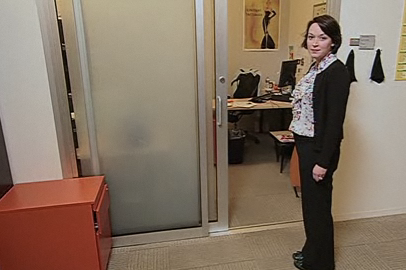
Many resources designed to help people use body language to succeed in business or romance would be appropriate to use in sessions with our teen or adult clients with social cognitive deficits. Check out this video from body language expert Carol Kinsey Goman on BNET. The video has specific examples of gestures people make with their feet that provide clues about whether they want to talk to you or not.
For example, this woman doesn't, because although she looks attentive, her feet are pointing away. She's totally over whatever the heck you are saying, and wants to go back into her fancy sliding glass door office. Where you aren't.
Crud. I probably do that with my feet all the time!
This video provides a nice jumping off point to some practice sessions with a pragmatic group!
For example, this woman doesn't, because although she looks attentive, her feet are pointing away. She's totally over whatever the heck you are saying, and wants to go back into her fancy sliding glass door office. Where you aren't.
Crud. I probably do that with my feet all the time!This video provides a nice jumping off point to some practice sessions with a pragmatic group!
Tuesday, April 6, 2010
Find movie clips!
The free film clip search engine Movieclips allows you to use some very interesting criteria to search its archive, including searching according to mood and character type. As movieclips allows you to view portions of all sorts of commercially released films, it would of course be a good idea to preview whatever you might want to present to students so it will be a swear-word free experience.
Language Lens
Presenting film clips depicting a certain mood or character type (e.g. "exciting" or "athlete"), in addition to other search criteria on the site, would be a great way to target emotional vocabulary, reading nonverbals, and story grammar.
Labels:
audio,
cognitive impairment,
emotions,
language arts,
news,
nonverbals,
operating systems,
story grammar,
syntax,
videos
Wednesday, March 31, 2010
Responsive Face
Responsive Face is an applet from NYU's Media Lab. The interface allows you to explore facial expressions with your students by selecting different facial actions, which can of course be linked to emotions. Thanks to Alex Laufer Lobo of Dramatic Pragmatics for sharing this resource with me.
Language Lens:
Language Lens:
- Students with social cognitive deficits lack emotional vocabulary and ability to read nonverbal cues. Creating lessons with Responsive Face, perhaps in a larger context such as exploring emotions in a book, video or real life event, is a motivating, interactive way to explicitly teach what different facial expressions mean.
Monday, March 22, 2010
Looking after the Dog
Interactive Whiteboards in classrooms are a popular tool nowadays, and many of the resources available to support their use are wonderful for students with speech and language issues. Looking after the Dog is a nice interactive featured on a whiteboard resource site from the UK--I think I will be revisiting the site to explore further. The activity can be a little repetitive (and alarming--this dog frequently needs to go to the vet to get a big shot!) but I have tried it with kids and they loved it.
Language Lens:
Language Lens:
- The activity is a perfect context for sentence construction with when and because- We know the dog is thirsty because he is drooling!
- This would lend itself to open-ended questions before the activity to elicit language (What do we know about dogs? How do we take care of dogs?) and some dramatic play with a stuffed animal dog after the activity.
- Social thinking instruction on the theme of "guessing someone's plan" would go well with this activity- we need to read the dog's body language to respond appropriately.
Wednesday, March 10, 2010
Go Ask Alice
Another current film that may be of interest to kids is Tim Burton's Alice in Wonderland. Open Culture recently highlighted this first known filming of the Louis Carroll classic, and posted the 9 minutes that survive from this silent version.
It would be worth comparing and contrasting with the trailer from the current release:
Language Lens:
- Working with the silent version would be somewhat like working with a wordless picture book in therapy activities, targeting narration, inference, and interpretation of nonverbal language ("thinking with your eyes") in Garcia-Winner parlance.
- Looking at both clips would be a great opportunity to complete a compare-contrast organizer, with all the valuable complex language practice that ensues (Both have black-and-white pieces, but the new one has some brilliant color also...)
Subscribe to:
Posts (Atom)