Tuesday, December 22, 2020

Wrapping up 2020. Thank God!

It was some year, for sure. In short, 2020 saw many of us becoming more tech-savvy because we had no choice and were working through an emergency. Still are. But there's hope ahead.

Myself, I admit to leaning in and then leaning out a bit. 2020 saw me writing about double the posts I had written in the past five years, because I wanted to be of use in the early days of the pandemic. Like everyone else I settled into "just keep swimming" mode and I hope weekly tidbits have been helpful enough. 

So, without further ado, here are the 10 most popular posts of 2020 in terms of page views:

10. What to: Using Google Slides for simple session agendas and visuals in telepractice

9. Demonstration of one activity you could do with Pear Deck

8. GIFs- simple animations

7. Mr. Nussbaum's Learning Fun

6. Explore ideas in EdTech Blogs

5. Creating a make-a-scene in Google Slides

4. Pairing Picture Books With Apps in Teletherapy

3. Vote with your wallet

2. ASHA Presentation 2019 on Telepractice

1. What to: Sharing Screens, Giving Remote Cursor Control, Using Interactive Websites in Distance Learning and Telepractice

Happy Holidays and here's to a brighter new year in 2021!

Thursday, December 17, 2020

Memorizer.me

As SLPs, at times we need to assist our students with work that is a bit pointless. I recall that Social Thinking® had some material about this; as students we are expected to follow the "group plan" and sometimes complete tedious tasks. Memorization of lists or passages is perhaps a good example. I recently needed to assist a student with memorizing a lengthy section from a book, I won't say which one. While the requirement was maybe in that zone of "Why tho?" it still was a good opportunity to apply Ehren's concept of the "strategic/therapeutic focus" and work on:

-ensuring comprehension of the passage as a whole and its vocabulary, sentence structure
-paraphrasing
-looking for opportunities for visualization
-noting language structure such as the flow from main idea to details in the passage, also several sentences had parallel structures that could be used as a memory trick i.e. adjective-infinitive, adjective-infinitive, adjective-infinitive.

Putting the passage in Google Docs and commenting in the sidebar with these memory tricks while discussing and eliciting paraphrasing and connections from the students made for a good teletherapy activity for a high schooler!

A quick Google search also found us this gem, which was great to leave my student with so that he could work on the actual memorization independently. Memorizer.me allows you to paste a passage or ordered list, then provides strategies and prompts to help you work on memorizing the language. For example, the website manipulates your pasted text to provide first letter or beginning of line cues. 


I recall having to memorize this above passage from Henry IV, Part 1 in high school and I wish I had had this tool!


Friday, December 11, 2020

Scaffolding complex and abstract language through Google Slides: an example

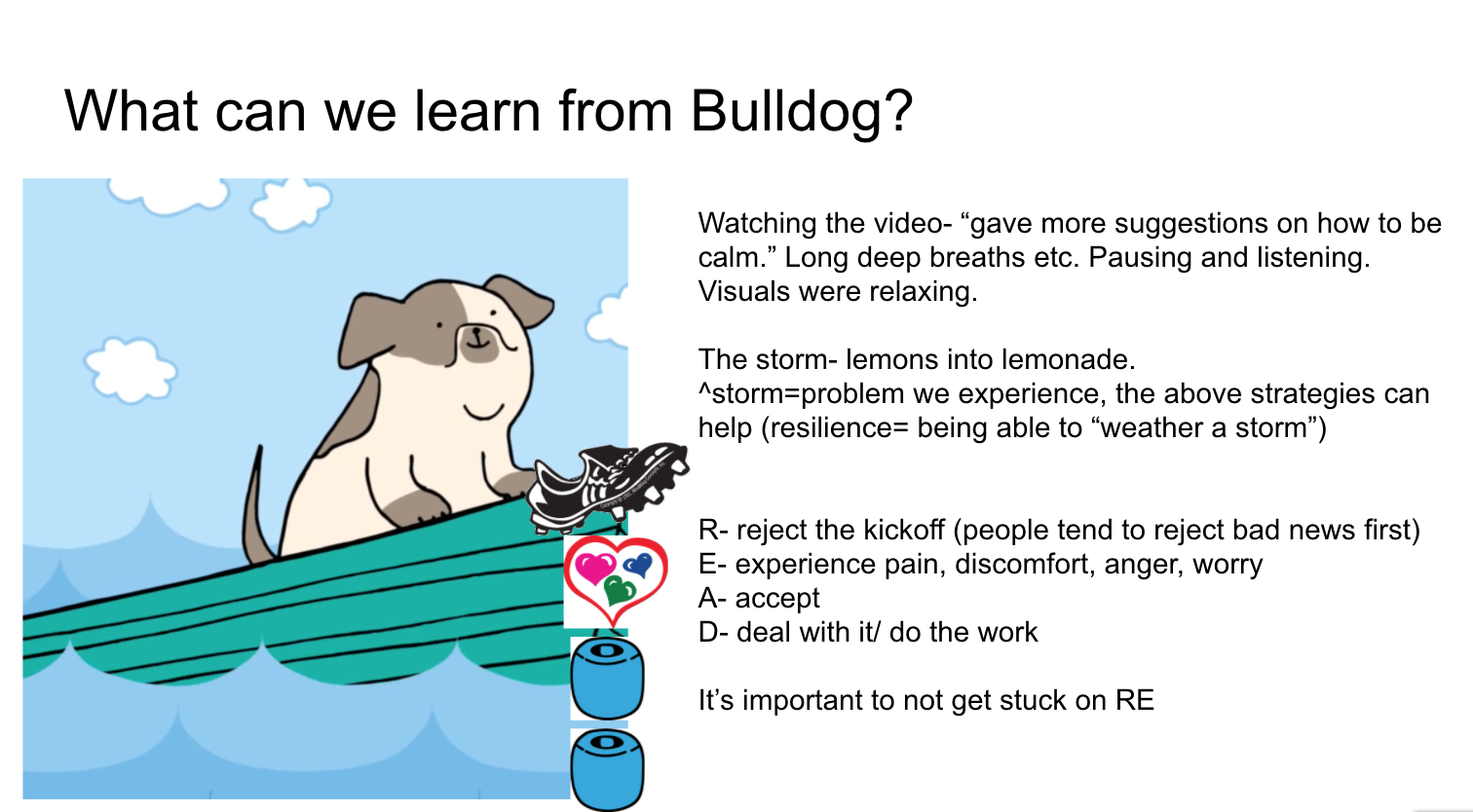
I have mentioned here many times that I am often seeking to target language and social competencies through a self-regulation lens of late. An example of a context for this is the great series of videos from the Stop, Breathe and Think-Kids app, now available free in full on YouTube in this playlist, see the right sidebar for full list. 

SBT-K presents mindful activities in a playful, narrative way and so is very useful for elementary students. As SLPs we can think of mindfulness cues like these as potential narrative/expository prompts (What did you think of when it said...?), connections to metacognition and self-regulation/social strategies such as Zones of Regulation®.

For a particular client these past several weeks, I have been using this series as a "flow" and creating in-the-moment visuals in Google Slides while scaffolding complex/abstract/how-can-you-use-this kind of language. A few examples are below, and remember that screenshots/screengrabs are your friend!


The READ acronym is one that I learned from MY therapist- how lucky I am to have a super solution-focused CBT support during a pandemic, and it corresponds well actually to story grammar (icons from Story Grammar Marker®)


As I mentioned, these are visuals we formed as the student, my graduate intern and I had this conversation over teletherapy; it occurred to me in the moment that many mindfulness activities are focused on lists, which are organized expository thinking!


Friday, November 20, 2020

Calm

This is a good week to remind you of a simple resource to help you and your students. I have written about Calm before but it seems it is more important than ever. We all need to take moments each day to reset and breathe.

Calm can be used as an app on mobile devices or Apple TV but I find that the web interface offers more, and particularly like the Scenes feature which can be used for free. To do this:

-visit the website, linked above.
-login with Apple ID, Facebook or create an account with your email.
-in the left sidebar click Scenes and choose a scene. Some are more setting-based and some more ambient visuals. You can choose the volume of the audio that goes with the scene.

-click Calm in the upper left corner, then the scene itself (not the featured activities) to see it full screen.

Calm could be a great resource to help you meditate and breathe a few moments if you enjoy visuals for this kind of activity.

For students, same. Also consider a post activity for some of the more contextual visuals. What place you have visited did this scene remind you of (could then go there with Google Earth and get some more narrative/description from the students). What do you think you would experience with your 5 senses if you were actually in this location?

Saturday, November 14, 2020

ASHA Pandemic Pangs

Facebook's "Memories" feature is sometimes not so great during a pandemic. You look back with a bit of a pang, right? "I can't do that this year..." This is best channeled with some hope, particularly with good vaccine news this week, toward better days ahead. But still, seeing past ASHAs kind of hurt. I'd always be prepping to present and seeing friends and colleagues I'd only see there. One very packed room I presented to in 2013 did kind of make me go "Ew," given current contagion.

This year, I was invited by SIG 18 and was set to present "Play on Words: Thoughtful Uses of Game-Based Apps and Resources in Language-Based Interventions." That presentation doesn't really exist as of yet (maybe next year), but I thought it might be helpful to share my presentations, along with one on telepractice with Amy Reid and Nathan Curtis, from the last three years. Hopefully there might be some ideas in there that will help you in your work currently.

Here's the link.


Food for thought: a lot of what I have presented in the past has revolved around iPad apps and these have been less relevant in the emergency-telepractice era. However, Apple has just released new Macs with their own M1 Silicon chip (as opposed to previous Intel-made chips) and THEY WILL RUN IPAD APPS NATIVELY. Kind of a game-changer for teletherapy, methinks. I will be getting one soon as my Mac is circa 2013, anyway. 

Friday, November 6, 2020

A focus on gratitude

Gratitude is a Thanksgivingy theme...but actually much more than that. Much research has supported that practicing gratitude as a form of mindfulness can be self-regulating and cultivate positive neural connections. 

In addition, gratitude has a language lens as it:

-relates life experiences

-can/should be practiced as a "listing" activity

-expresses causality

-can be pushed to the abstract i.e. being grateful for intangible things.

Over this and coming weeks I will be using this and this video in discussion activities.


Both are accessible, short and visual. Videos from Headspace are very useful that way, and the second has a bit more of a near/practical hook that will help a lot of my boys access what could be perceived as a dismissible touchy feely message.

As a follow-up activity, Jamboard is a motivating visual way to have students journal, share, describe and discuss. Here's my model:


Thursday, October 29, 2020

Mindfulness "fails" for narrative and "thinking talk"

Metacognition is all wrapped up in our language, social and executive functioning. To read a great explanation of how, see this article from Singer and Bashir (1999), two of my faves in the field. 

Additionally, right now everyone, absolutely everyone, needs strategies for regulating ourselves. I have made it a focus in many of my sessions since March. 

Recently Chris Hemsworth of Thor fame, so familiar to most of your students, put out a number of humorous videos showing that mindfulness failure is all part of the process (note that there are 6 videos in the series/playlist).

These vids are useful in a number of ways in speech and language sessions:

-mindfulness exercises are a great entryway to metacognitive talk: "during that I was thinking about..."

-you can pair these with actual exercises, see MyLife, Stop, Breathe & Think Kids, Calm, Zen Den, or MindUp's Curriculum

-each video is actually a narrative snippet: character, setting, initiating event, plan, actions/attempts, conclusion, so is good for mapping

-I actually used these in some lessons about humor for a student struggling with humor use, teaching about types of humor including play (Ward/Jacobsen's "same but different" concept is related to that type of humor and these videos)

Thursday, October 22, 2020

Google Earth's Spooky Spots Quiz

You know I am a Google Earth Geek. Always have been, but in this time it is nice to be able to use the context of "going someplace" to engage my students. Google Earth's quizzes (find in the Explorer captain wheel tab) provide very structured experiences with the interactive globe, posing questions, providing images that prompt observation and discussion, and popping you into an interactive window to "look around." With Halloween coming, you can use the Spooky Spots quiz through nine multiple choice questions (it doesn't matter if you or your students know the answers) bringing you to spots around the globe. The content is free of violence but mentions "The Shining" and "Rosemary's Baby" so probably best for 5th grade or above. As each question is posed, unlabeled placemarks would allow you to ask students to observe potential locations (e.g. "that one looks like its Colorado."). Once answered, you can use the interactive window on the left to navigate the space (oooh an abandoned amusement park near Chernobyl) and work on description and conversation. You may be interested in asking group members to get more information on one of the topics and report back to the group (Wikipedia is fine for general knowledge!). 


Friday, October 16, 2020

Genius and the metalinguistics of popular songs

Genius is a great website for looking more deeply at any song, and most you can think of are covered on the website. Just locate the song, and highlighted sections of it are annotated in the right sidebar. Songs are motivating "texts" (provided you find ones appropriate enough AND motivating) for higher-level language skills (e.g. identifying sentence structures, vocabulary, figurative language, multiple meaning, and narrative, particularly for older students).


I thought to feature Genius because, anecdotally, I do some consulting for a suburban high school (currently remotely AND in person, Thank God I get to leave my house sometimes) and a particular student who wants nothing to do with me nonetheless needs a consult. I heard that his small ELA class is tackling Hamilton, so I insinuated myself into this situation and offered his teacher some content in Google Slides. I was thinking of facial expression work from the Disney+ recording, but ended up starting to package this more as metalinguistic discussions (he needs that)! I first discovered Genius because of its Hamilton lyrics analysis, so I also talked to his teacher, who was thankfully very open, about the site. Yay for language underpinnings! You can view what I came up with so far below or here. As always, please don't request permission for this Google Apps item; if you want to save or edit it, File>Make a Copy.
 

Friday, October 9, 2020

Therapeutic Gaming Can Be Messy...

 ...and that's ok. Particularly in social intervention contexts, it's important to facilitate natural situations. That includes trying and failing with games- either because the group doesn't like the game and wants to try something else, the game itself sucks, or for other reasons. Isn't that what friends do when they get together-- evolve "group plans" and move on when something doesn't work for the group (see Social Thinking® Group Plan concept)? I like to use games within intervention sessions as a seeming reward near the end, but in themselves they have working teachable moments and lots of opportunities for my students to practice self-regulating. In teletherapy, with or without cursor control (have the students tell you what to click on), you can try a flash game like this (seasonal!) corn maze. Flash games come in a wide range of quality but this one is not bad at all!

While accepting that games like this might not go perfectly in a group, we can prepare to facilitate success. Notice that button that says "walkthrough?" In this case it leads to a video that shows you a sped-up view of game moves. For most other games, you can find a walkthrough with a Google. This arms you with information so you can provide cues like "Oh, what do you think that quarter will be for? What might you buy in a corn maze? Oh, nice smart guess!"

 
.